
Interview With Creative Team From Be Gay, For God’s Sake
Why tell a story about being gay? What is it like in an East Asian background? Discover how the mother-daughter relationship and the gay experience across different generations shape the story.
INTERVIEWS
T Wu
12/8/20256 min read
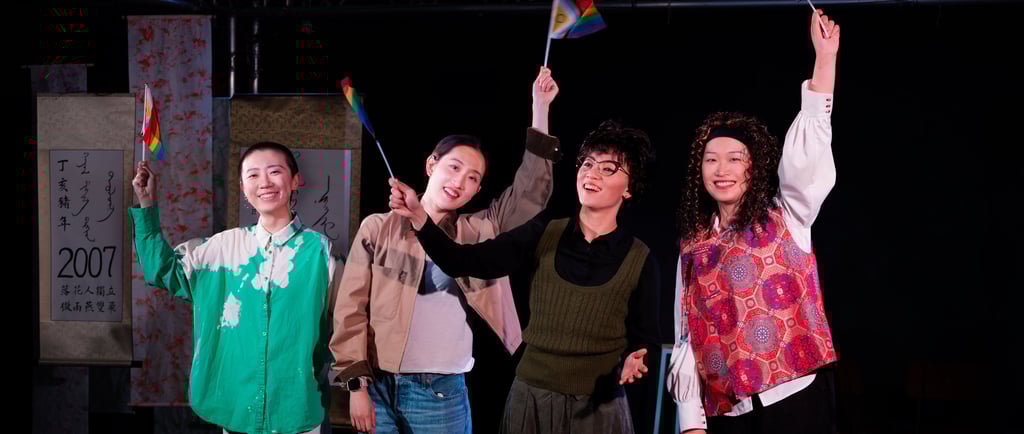
Interviewee: Haoyu Wang, Katherine (Meiyu) Guo, Hector T.J. Huang, and Tianxin Tian
Interviewer: T Wu
Q: What first inspired you to create Be Gay, For God’s Sake? Why did you decide to focus on this particular theme and story at this moment?
Haoyu Wang: The project began with a bit of my own experience and confusion. I’d always wanted to bring this story to the stage, so about two years ago, I shared it with my friend Xinzhu. She shaped it into a short draft, and that became the starting point for what followed, months of reworking, expanding, questioning, and slowly shaping it into the script we have now.
Why now? On a personal level, I feel I’m at a point where I understand my own voice better, and I have a clearer sense of how to hold a story onstage: how to shape it, how to let it speak. And beyond the personal side, themes such as East Asian mother–daughter dynamics, the way queer people search for identity, and the boundaries between faith and the self have always been important. These themes sit very sharply within the cultural conversations happening around us.
Q: You’ve mentioned that “the story grew out of real conversations with our families .... how time, society, and fear shaped their choices.” Could you share more about these real-life experiences and how they influenced the development of the play?
Haoyu Wang: In fact, it wasn’t one specific moment or conversation, but rather a series of small, lived experiences. When someone comes out to their family, the story isn’t just about queer self-expression. It also brings up intergenerational questions, shifts in society, and different understandings of faith. In the last generation’s view, being true to yourself was often less important than avoiding gossip or following the social clock. Expressing yourself authentically was secondary to adhering to expectations.
All of this led us to think about how East Asian moms’ love and sacrifice shape choices. Are the compromises made to conform to family or society truly necessary? So, in Be Gay, For God’s Sake, we have God turning the clock, exploring whether life could have been different, and if changing the past would lead to greater happiness. We became especially interested in how time and society shape people and those moments of silence, hesitation, and words left unspoken. Can they still be said, even now?
Q: Be Gay, For God’s Sake is described as a sharp, time-bending queer comedy drama infused with satirical mischief. What do you think sets this production apart from other queer comedy-dramas? And why was this the right form to tell this story?
Katherine (Meiyu) Guo: What sets Be Gay, For God’s Sake apart is its blend of an East Asian queer lens, a time-bending structure, and a satirical tone that allows the story to hold both pain and humour at once. Our narrative looks backwards — at the buried loves, lost chances, and the “had-to” decisions of an older generation — and places them alongside the journey of a present-day queer daughter who is struggling to come out to her mother.
The time-jumping structure, paired with our unhelpful and sarcastic Gods, creates a storytelling form that is playful yet emotionally revealing. It lets us revisit the past not with judgment, but with curiosity: What pressures shaped the lives of our parents? What choices were denied to them? And why do these unspoken histories all echo in queer families today?
Comedy and satire felt like the right tools because tragedy alone could not capture the complexity of this mother–daughter relationship. Humour allows us to reveal the absurdity of prejudice, the contradictions between faith and family duty, and the emotional miscommunications that love often creates across generations. It softens the audience just enough so they can look at difficult truths without turning away. For many East Asian queer people, ourselves included, our family stories sit exactly at this intersection of pain, duty, confusion, and ridiculousness.
Ultimately, the show stands out because it pairs emotional honesty with mischief. It refuses to flatten queerness into suffering or reduce culture to stereotype. Instead, it uses comedy, time travel, and satire to honour the stories that were never allowed to be told — while inviting audiences of all backgrounds to laugh, reflect, and find pieces of themselves in the chaos.
Q4: There are three playwrights involved in this production: Haoyu Wang, Tianxin Tian, and Hector T. J. Huang. Could each of you share which parts of the play you were mainly responsible for, and how you individually contributed to the development of Be Gay, For God’s Sake?
Haoyu Wang: The creation of Be Gay, For God’s Sake has been a very collaborative process. The initial concept of the story started with me, which gave us the direction for developing the piece together. I worked on the overall structure of the play and the development of the story framework, and I was also involved in shaping the main character, Lin Song. Alongside this, I drafted several scenes throughout the process. Even so, the work grew through continuous discussion and revision with the team, which is why I see it as very much a collective creation.
Tianxin Tian: We began by meeting together to discuss the overall structure of the show, using the original text created by Haoyu and Xinzhu as our foundation. From there, we divided sections for each of us to write or develop individually. At our next meeting, we read everything aloud, offered feedback, and revised the material collectively. This often generated new ideas or ‘tasks,’ which we then worked on separately before repeating the cycle.
The way we worked was fundamentally collaborative; that is how our group, Oh My My, works. If I have to highlight something specific, then I’d say I proposed the idea of including God as a character and helped set up the structure around those scenes. I also drafted the moment where two spaces appear simultaneously—Hu Yi rehearsing her confession while Lin Song and Shasha talk. But again, all of this was shaped, changed, and strengthened through Oh My My’s collaboration.
Hector T.J. Huang: We reviewed the initial story by Xinzhu and Haoyu together and came up with the story structure and the main beats for the play. After that, we delegated various scenes to individuals to write. My contribution was mainly to do with the primary school teachers, Hu Yi, and Mrs Lien’s character building. The main scenes I’ve written were the disco scene and Mrs Lien’s monologue and her snarky remarks here and there. I was responsible for building Yi and Song’s relationship progression, so that it was clear that they were falling for each other (Song…in a way) but also struggling with their internalised limitations from the social environment.
A lot of Yi’s monologues and backstory didn’t make it to the final draft, but we think it’s for the best. And it was good that we thought through her character and backstory so that we, as playwrights, understand her deeper than the audience, who was only given a surface glimpse into Yi’s life. Mrs Lien’s character sort of emerged out of nowhere and took on a life of its own. She was initially just mentioned as a villain-type character in school, but I gave her more screen time, almost as revenge for people like her who plagued our childhood. She was modelled after Tianxin’s school teacher, and her religious fervour was inspired by my charismatic, tongue-speaking Christian childhood female figures. We each reviewed the script many times and did revisions here and there, so I also edited the script alongside everyone else.
Q: What do you hope audiences will take away from this show after watching it? Did they?
Katherine (Meiyu) Guo: What we hoped audiences would take away from Be Gay, For God’s Sake was a deeper understanding of a Chinese mother–daughter relationship told through an East Asian queer lens — a perspective that is still extremely rare on stage. Beneath all the humour and chaos, the show explores curiosity, repression, and the emotional ‘what-ifs’ that shape queer lives in conservative cultural contexts. We intentionally chose not to present this story through tragedy. By leaning into humour and dark comedy, we wanted audiences to laugh, reflect, and recognise the humanity and contradictions within both characters.
At a time when social and ideological divides feel sharper than ever, we hoped the show would encourage people to see that even the most difficult conversations can be softened through empathy and laughter. If we can laugh together, we can begin to bridge generational and cultural misunderstandings — instead of letting them harden into fear or judgment. And while the story is rooted in an East Asian family context, its emotional truth is universal: the resilience, quiet love, and complicated negotiations that LGBTQIA+ people face across generations.
Based on audience feedback, we believe they did. Our audiences—queer, Asian, or neither—told us they recognised their own families in the show, and that the humour made space for honesty rather than defensiveness. Some audience members shared that the story helped them reflect on their own parent-child relationships with more compassion. Others appreciated seeing an East Asian queer perspective represented onstage, saying it felt both refreshing and overdue.
Overall, audiences walked away laughing, thinking, even crying, and we hope — feeling a little more open to stories that sit between cultures, identities, and generations.
Find more about OH MY MY, please visit: https://linktr.ee/oh_mymy?utm_source=ig&utm_medium=social&utm_content=link_in_bio&fbclid=PAZXh0bgNhZW0CMTEAc3J0YwZhcHBfaWQMMjU2MjgxMDQwNTU4AAGnDB19yeiludy-HT4JhBo3AFmhpyLYZtlCyqtkgwTQfbCx1TACzVpStYu9xjE_aem_2McxfcZaIvDlt3SfYy3hTg
©️Photo by Xuan Zhao (May)
Sound Behind Curtain
A place for all Asian artists.
Your gift keeps the curtain rising for Asian creatives.
About
Contact
© 2026 Sound Behind Curtain. All rights reserved.
Terms & Conditions Privacy Policy