Interview With Creative Team From RAT RAT RAT
Creative team from RAT RAT RAT shares insights on staging historical trauma through the lenses of audience observation, systemic power structures, and the physical choreography of the rat.
INTERVIEWS
Arin Lin
6/15/20267 min read
©️Photo by Alyssa Tianai Zhou
Interviewee: RAT RAT RAT creative team
Interviewer: Zoe Yingying Xie
Q: The Old Operating Theatre is a place loaded with histories of observation, education and medical practice. How does this theatre become an important part of RAT RAT RAT instead of simply a backdrop for the performance?
Selene(Set Designer & Dramaturg) & Zoe(Producer):
Of course, this piece really began with the Old Operating Theatre itself.
As we researched the venue, we became interested in how histories of medicine and medical ethics are often tied to observation, education, experimentation, and systems of authority. From early surgical demonstrations and animal testing to more extreme examples of violence carried out in the name of scientific progress, these histories shaped the world of the piece and the rat characters within it.
For us, the venue is not just a backdrop. Its real historical weight creates a sense of surgical observation that would have been almost impossible to build from scratch, especially for a work still in development, in terms of design, time, and budget.
Because the audience sits inside a space where people once gathered to watch medical procedures, the theatre becomes an active part of the story, allowing ideas of learning, obedience, and cruelty to unfold through the performance.
Q: Historically, surgeries in this theatre were performed before live audiences. RAT RAT RAT also places audiences in the position of observers. Did creating the show inside the Old Operating Theatre change the way you thought about the relationship between performers and audiences?
Jonathan(Movement Director) & Xintian, Caiqi, Yi(Performers):
Proximity is the first thing that comes to mind. The space is quite intimate, and when it was used for medical practice, everyone in the room would have been able to see the details of the procedures. That quality definitely shaped how we thought about the relationship between performers and audiences. We tried to keep more subtleties in the performance and invite the audience to look closely, rather than simply telling them what to see.
There is also a playful and slightly unsettling relationship between the audience and the rats. Can the rats see them? Are the audience part of this experience? Are they allowed to interact? Each audience member has to make up their own mind. In the museum exhibition, there are accounts of some onlookers covering their eyes, while others were completely transfixed. I think there is something similar in how our audience might respond to the work.
Performing in the museum also changes the feeling of being watched. Unlike a conventional theatre, the audience is placed above the action, looking down into the performance area. This immediately creates a sense of observation, curiosity, and judgment. For the performers, it can feel less like being on a stage and more like being examined, almost like a specimen.
Because the audience has already passed through the museum before entering the theatre, seeing surgical instruments, medical objects, and anatomical specimens, they arrive with that history already in their minds.
Q: The work draws from the histories of animal experimentation and Unit 731 during the Second World War. What first led you to these materials, and how did they gradually transform into the world of RAT RAT RAT?
Selene(Set Designer & Dramaturg) :
What first drew me to these materials was the contradiction that some of humanity’s greatest medical advances have come from deeply unethical practices. Around the same time, I was interested in experimenting with costume design on taxidermy forms and began building a taxidermy rat myself as part of my design research.
Freya & Yifei(Costume Designer / Assistant):
What interested us was not only the cruelty of these events, but also what they revealed about education, obedience, group management, observation, training, and the position of the individual within a system.
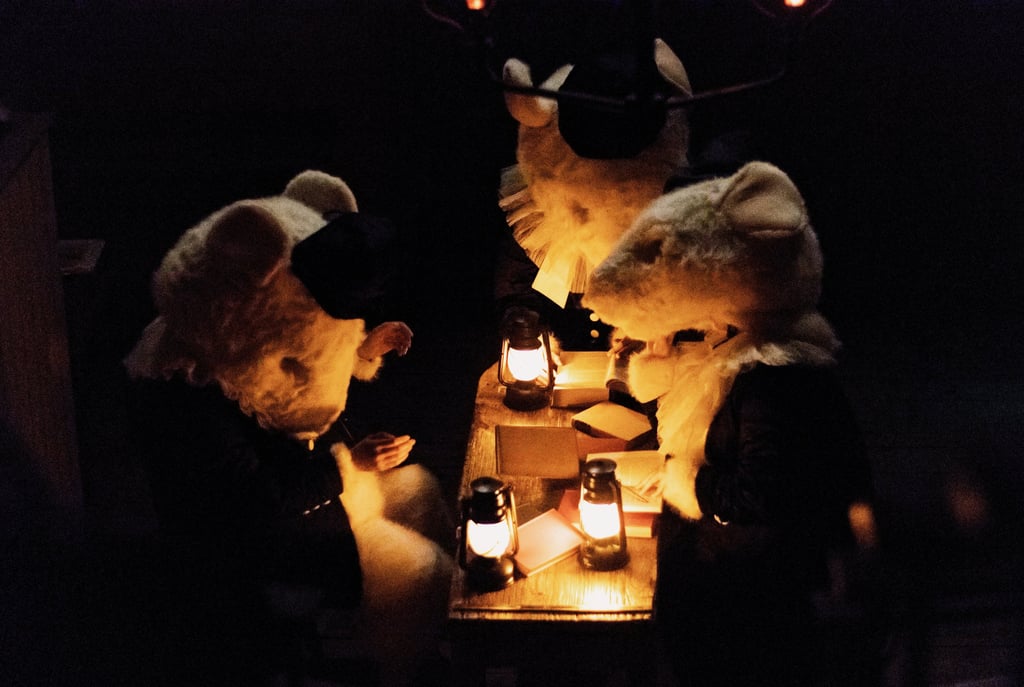
After discussing the characters with Selene, we wanted to express these ideas through costume rather than language. In the design, we chose a black-and-white palette, school uniform elements, matching hats, and ruff collars, so that the characters would appear both cute and disciplined. At first glance, the audience may be drawn to these anthropomorphised rats, but on closer inspection, they can also sense ideas around regulation, education, and group behaviour.
We wanted to create a classroom where training, observation, and experiment slowly become indistinguishable. The students begin by learning and imitating, but the system eventually turns their bodies into specimens.
Mira(Sound Designer):
I was particularly interested in how these historical materials could be translated into atmosphere, rather than represented literally.
Instead of creating realistic or historically specific soundscapes, I focused on building a world that feels simultaneously playful, absurd, and unsettling. Waltz motifs, distorted screams, mechanical rhythms, and exaggerated transitions all became ways of expressing the instability of the world the rats inhabit.
Through sound, I hoped to support the production’s dark humour, while also allowing moments of discomfort to emerge, reminding us that beneath the absurdity lies something much more disturbing.
Q: Rats are the central figure of the piece. Rather than symbolic representations, they appear as part of an organised system. What did the figure of the rat allow you to explore that other images might not have?
Freya & Yifei(Costume Designer / Assistant):
Rats allowed us to explore discipline, imitation, fear, and obedience without turning the piece into a direct human classroom narrative.
What makes the rat especially interesting is its contradictory nature. Rats are small and vulnerable, but also highly adaptable and resilient. They are social animals, but each rat can still carry distinct behaviours and characteristics. They are often ignored or rejected, yet they continue to live on the edges of human society. This double identity made them a powerful way to explore the relationship between the individual and the group, freedom and rules, care and procedure.
For costume design, this contradiction gave us a lot of space to work with. We used shared visual elements, such as similar silhouettes, a black-and-white palette, matching hats, and uniform-like details, to suggest that the rats belong to the same system. At the same time, we kept small differences between them to show their individual personalities and positions within that system.
Mira(Sound Designer):
What interested me about the rat is its ambiguity. The rats are not stand-ins for specific people. Instead, they exist within a system, which allowed us to explore questions of hierarchy, conformity and collective behaviour. There is something simultaneously comic and unsettling about them, and I think that tension sits at the heart of the piece.
I was particularly drawn to that balance. The world of the rats could be playful and absurd one moment, then suddenly reveal something darker underneath. For me, that constant oscillation between humour and unease is what makes the image of the rat so compelling.
Q: The work seems less interested in individual cruelty than in systems that make cruelty appear rational. Were there particular institutions or social structures that informed your thinking during the creation process?
Zoe(Producer) & Yaqi(Lighting Designer):
The work focuses on how a system can gradually make cruelty acceptable. Throughout the creation process, we kept thinking about what happens when violence is placed inside a classroom, a laboratory, a hospital, an army, or any space with rules, hierarchy, and instructions. It no longer appears simply as “violence”. Instead, it can be packaged as learning, discipline, efficiency, science, obedience, or even the pursuit of a greater good.
I have been surprised, though not pleasantly so, by how deeply both Chinese and British societies are shaped by informal networks, social conformity, and the desire to belong. People can do a great deal to fit in, to preserve a certain “good vibe”, or to avoid disrupting the room.
This is why I have become increasingly interested in systems rather than individual cruelty. Any system, whether it is a fight club, a war machine, an educational institution, or even a pub full of devoted football fans, contains powerful forms of collective suggestion and consent. People learn what is acceptable, what should not be questioned, and what it takes to belong. That process can be quiet, ordinary, and almost invisible, which is exactly what makes it so unsettling.
Q: The work brings together a Japanese wartime history and a distinctly British museum context. How did these two sites of knowledge and authority begin to resonate with each other during the creation process?
Joe(Props Supervisor) & Colleen(Stage Manager)&Yaqi(Lighting Designer):
We gradually found that both the Japanese wartime history and the British museum context raised similar questions about knowledge and authority: who has the power to observe a body, to explain pain, to turn a living being into an object of study, and who is forced to endure all of this in silence.
Instead of introducing explicit wartime objects, we used items that belonged naturally to the museum’s visual language, such as vintage books, oil lamps, aged wooden furniture, and medical instruments.
There was also a resonance in terms of historical visibility. The Old Operating Theatre reveals a history that many people know very little about. Similarly, the atrocities that took place on the East Asian front during the Second World War, including histories such as Unit 731, remain relatively overlooked within many global narratives of the war. While there are many necessary and important theatre works reflecting on European fascism and the Holocaust, stories from Asia are rarely given the same visibility. That absence became important to us. The silence around these histories asks whose suffering becomes part of collective memory, and whose stories remain peripheral.
Q: The rats are not simply characters but physical bodies moving within a system. How did you design their movements that could express obedience, resistance, and personalities?
Jonathan(Movement Director) & Xintian, Caiqi, Yi(Performers):
It came from a lot of trial and error, and a lot of help from the performers. We began rehearsing without the costumes, but once the performers started working in the rat heads and suits, we began to explore more performative and exaggerated movement qualities. The costumes give the rats very distinctive shapes, so our main focus was making sure that a look, a tilt of the head, a reach, or a sudden stillness could be clear enough for the audience to understand.
Because they are rats, we also paid attention to specific animal behaviours: freezing, moving along edges, looking upwards, quick jumps, the flexibility of the head, and sudden shifts of energy. Compared to humans and compared to the authority inside the classroom system, the rats are small and vulnerable. That physical vulnerability became important in showing how they respond to rules, pressure, and control.
At the same time, each rat has a different relationship to the system. One rat’s obedience is not simply forced, but already internalised into the body. The movement becomes direct and automatic: receiving a signal, following, repeating, keeping order, and responding quickly to instruction. Another rat is more inward-looking, drifting off track, catching their own tail, and retreating into their own thoughts. These gestures create a sense of self-care and separation from the other, more obedient rats. Another begins from a more playful, fluffy, and innocent physical quality, but as the work develops, moments of stillness, focus, and tension begin to appear.
Find more about RAT RAT RAT, please visit: https://www.eventbrite.co.uk/e/rat-rat-rat-tickets-1984672441699
Sound Behind Curtain
A place for all Asian artists.
Your gift keeps the curtain rising for Asian creatives.
About
Contact
© 2026 Sound Behind Curtain. All rights reserved.
Terms & Conditions Privacy Policy