Interview with Jungyun Lee about Heaven, Hell, and Somewhere Else
Jungyun Lee/Gimachim (b.1999) works in performance, text, drawing, and sculpture. As a student on the MA Performance Design and Practice (MA PDP) programme at Central Saint Martins, she is bringing Heaven, Hell, and Somewhere Else' to the Platform Theatre, Kings Cross on Tuesday, April 21.
INTERVIEWS
T Wu
4/8/20266 min read
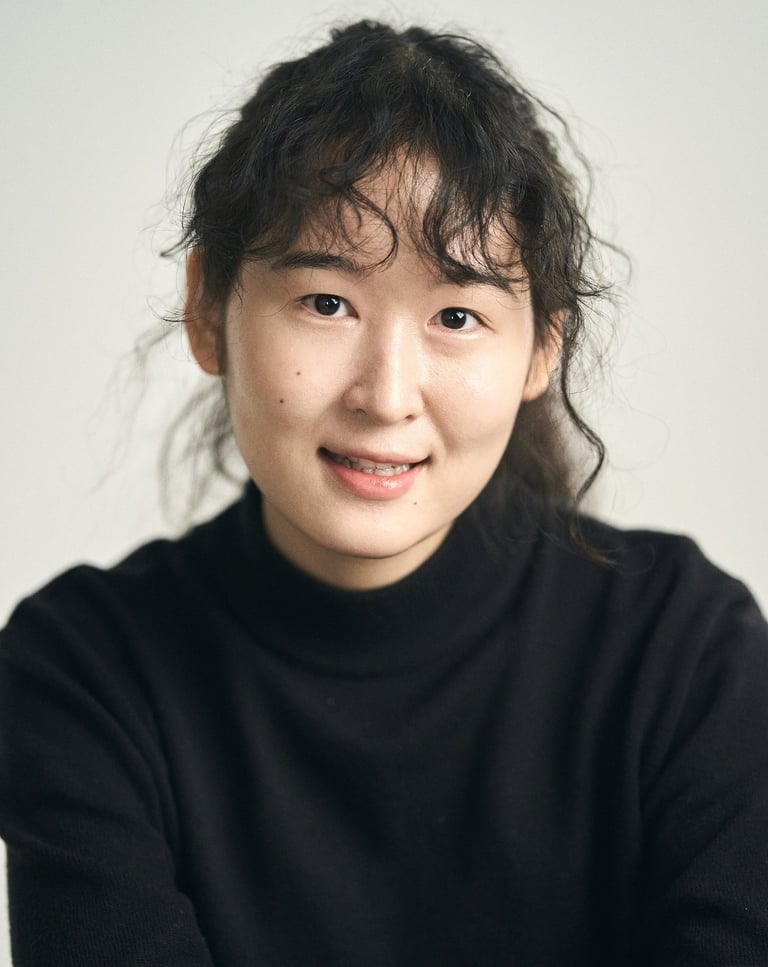
©️Jungyun Lee (Gima Chim), photo by Actorswastudio
Interviewee: Jungyun Lee (Gima Chim)
Interviewer: T Wu
Q: You mentioned a belief that art can approach something spiritual, and that your work aims to create something that might actually heal or solve something. Could you tell us more about why you believe this, and how this idea influences your creative process and your work?
A: I started making work as a way to deal with my own problems — to fix or heal something in myself. I made a fake first-aid kit containing fake knives with soft fabric frames to resist self-harming urges. And built a prayer stand designed for lying down, because I felt guilty about not kneeling before bed. I made a video of myself running from a hospital to a church, because I wanted to redefine and re-edit the thing that had led to my psychiatric hospitalisation, which was the church, religion. I also kept writing poetry, pushing my imagination all the way through — how I might die, what it might be like afterwards. And doing all of this, I genuinely felt that something was being healed, resolved.
But then other, new problems would appear, and I'd think of new approaches, realise them, resolve them — and the cycle repeats. The targets I want to resolve seem to have started from something very personal, and are gradually expanding outward, becoming more social.
Beyond my own experience, looking at other works I love, I've come to feel that the ultimate aim of art is spirituality — that art can play a religious role outside of religion. That's what I want to pursue.
Q: “Heaven, Hell, and Somewhere Else began from a desire to interpret and receive suicide impulse differently - having grown up in Korean society where suicide is a significant social issue” Could you share more about this social and cultural background, and how it shaped the starting point of this work?
A: I've been exposed to news of suicide since I was young. From my teenage years, hearing about the deaths of actors and idols I admired. Then, closer: someone who died in the same apartment complex, friends of friends, a student at my university. From as far away as a president, to as close as that. I also spent time in my early twenties in the depths of depression, living alongside suicidal impulses. And even now, I still come across such news with some regularity.
I alone cannot stop it. I don't even have the power to. But perhaps that's exactly why — I wanted to show those who have survived a suicide attempt, those who have thought about it, those who have lost someone to it — how I reinterpret and re-edit it for myself.
Q: You mentioned that the work draws from the phrase “bless you,” which has no direct cultural equivalent in Korean and East Asian societies. This is a very interesting and specific cultural reference. Could you explain what differences it carries, and how this idea influenced the development of the work?
A: In Western culture, saying "bless you" after a sneeze is a wish that the soul won't escape the body — and historically, a wish that the person won't die of the plague. Because this doesn't translate into Korean or East Asian culture, the same moment feels, in English, as though God is present, and in Korean, as though God is absent. I wanted to use that gap in the performance.
There's also something else in the phrase itself: because "God" is omitted, "bless you" can also be heard as I bless you — as if the speaker is the one doing the blessing. That connects to a sentence I've carried across my previous work: "If I could create clouds, I might be god." Through the act of making clouds, the work occupies the position of god, and "bless you" became another way into that same idea.
Q: This work is also your final presentation as part of your MA at Central Saint Martins in Performance Design and Practice. Could you tell us more about your journey in the UK and your personal experience navigating the UK theatre and art scene as an international artist?
A: My background is in fine art, and this is also my first time living in another country. So in some ways, everything about this experience has been new at once — a new country, a new language, and a new discipline.
There's something particular about encountering theatre in a language that isn't my own. Watching a performance in English, I'm always operating with a slight distance — processing meaning and sound simultaneously, sometimes losing one to follow the other. That experience has actually fed directly into this work. Heaven, Hell, and Somewhere Else exists in both Korean and English, and I think that bilingualism isn't just practical — it's part of what the piece is about. Something always escapes translation. I wanted to make that visible rather than paper over it.
This is also the first time I've worked properly within a theatre space. My practice has lived mostly in galleries and exhibition contexts, and moving into performance has meant learning a different set of logics — how time functions differently on stage or in a given space, how an audience's presence changes the work in real time. I'm still learning, and I've found that I don't want to choose between the two. I'm looking for ways for gallery space and performance space to coexist within a single practice.
I haven't been as active outside of school as I might have liked — honestly, navigating a new country takes more out of you than you expect. But being in London has made me want to explore more, to find more points of entry into the performance and arts scene here. That feels like something still ahead of me.
Q: In your work, there is a powerful question: "There’s someone who wants to kill themselves. Do people who die by suicide go to hell?" How do you explore this question in the performance, and how do you translate such a complex and sensitive topic onto the stage?
A: Alongside reinterpreting suicidal impulse, another goal of this work is to visually reinterpret heaven and hell. In Korean, heaven is cheon-guk — literally "the country of the sky." But does heaven have to be somewhere above the sky? Is the sky always blue? Is hell a burning place — and is fire always red? I noticed that churches in Korea never use red in their logos.
There's a bestselling Korean essay titled I Want to Die, but I Want to Eat Tteokbokki. If the heat and spice of tteokbokki can keep someone alive, then for that person, it is heaven. Drawing on this Korean context — where food is so intimately tied to emotion — I use tteokbokki and a blue gas flame to evoke hell, while heaven is made of clouds of farts, burps, and sighs, and images of a sky red with sunset glow. Moving between these, I try to imagine where heaven and hell might actually be, what they might look like — and to blur the boundary between the two.
Q: What do you hope audiences will take away after watching Heaven, Hell, and Somewhere Else?
A: When someone wants to die, they're supposed to think about why they should live. But the meaning of life is something each person finds for themselves — there is no answer to the question of what you were born for.
The line "I was born to love — I was born to learn infinite love — I was born to be god" repeats throughout the piece. This is my answer to why I was born. Even in the moments when it feels God is completely absent, life is something you have to keep going with. So how do you live? Comforting you — us — who haven't died yet: you pee again, you fart, you keep eating and excreting.
After realising that I can be God, the way to live with trauma, the way to absolutely never die, even when you want to, is to believe that the fart I just let out, the burp, adds one more cloud to the sky. It's almost as absurd as dropping a single tear into the ocean. But if I'm alive and doing it for the rest of my life, I am contributing.
I hope the audience can take away this concept at least once — when they fart, when they burp — they can think: I could be god. When they sneeze, or they say ‘bless you’ to someone who sneezed, they can think: I could be god.
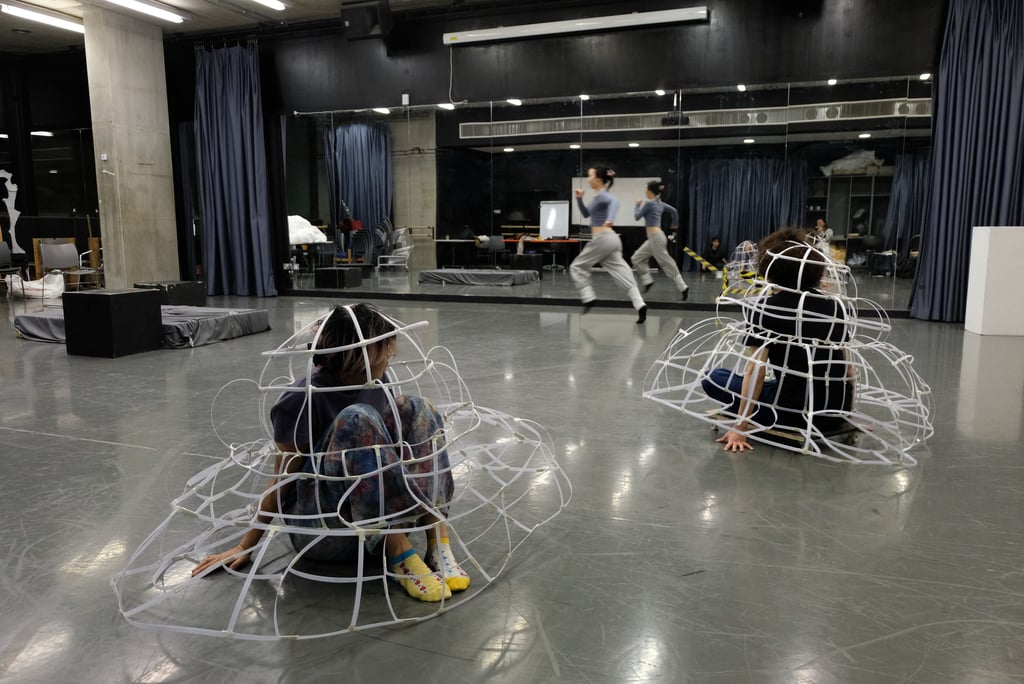
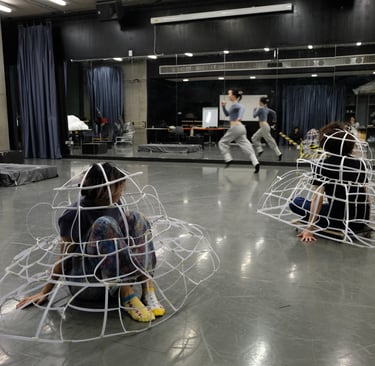
©️Photo by Shuyi Alice Wang
This show will be performing at the Platform Theatre, Kings Cross on 21st April 2026 for one night only.
For more information about Heaven, Hell, and Somewhere Else, please visit: https://www.eventbrite.co.uk/e/heaven-hell-and-somewhere-else-tickets-1985369857689
Follow Jungyun Lee/Gima Chim on Instagram @gima_chim
Sound Behind Curtain
A place for all Asian artists.
Your gift keeps the curtain rising for Asian creatives.
About
Contact
© 2026 Sound Behind Curtain. All rights reserved.
Terms & Conditions Privacy Policy