
Interview with Tristen ZiJuin about Bayangkan Bayang [Imagine a Shadow]
Tristen ZiJuin, born in Malaysia and now based in the UK, brings a distinctive Southeast Asian lens to London's theatre scene. This March, Tristen is bringing a powerful new work, Bayangkan Bayang [Imagine a Shadow], to Camden People’s Theatre
INTERVIEWS
T Wu
3/19/20267 min read
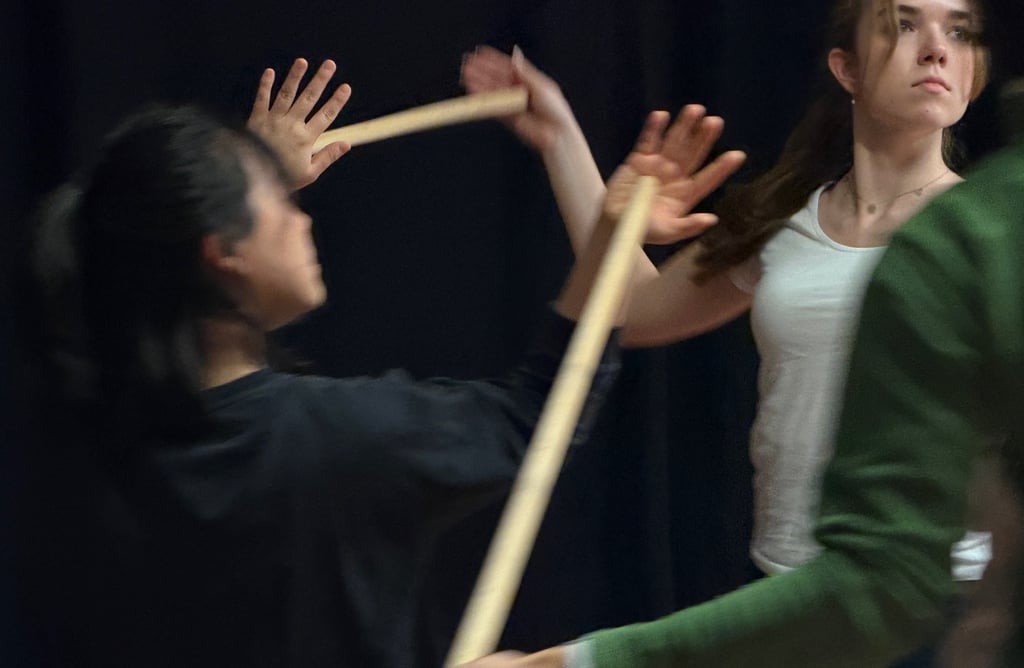
©️Photo by Leanne Lim
Interviewee: Tristen ZiJuin
Interviewer: T Wu
Q: The title of the piece is quite intriguing. How did it come about?
A: Well, the title, Bayangkan Bayang, translates directly from Malay to "Imagine a Shadow” in English. And I chose to lead with the Malay title followed by the English translation as a deliberate act (a little provocation if you will).
Stateless people are often hidden in the shadows of society: forgotten, reduced to statistical reports, denied the right to exist. The title gestures toward that invisibility. But the choice to use Malay first was also my way of exploring the "otherness" that stateless people, to a broader extent, migrants experience on a daily basis. It's about code-switching, about exchanging pieces of your culture to assimilate, to integrate, to be accepted.
I'm interested in how a British audience might respond to a title they can't immediately pronounce. Apprehension? Intrigue? Wariness? Fascination? All of those responses are valid, and all of them are part of the encounter I want to create. The title is an invitation to sit with discomfort, to imagine a shadow, to wonder what or who exists just beyond your frame of reference.
Q: This work combines physical theatre, shadow play, original music, and spoken word. Why did you choose such a multi-disciplinary form to tell a story?
A: Because statelessness itself is multi-dimensional. It's legal, emotional, physical and spiritual all at once. No single form could hold all of that. Physical theatre allows us to explore what it feels like to carry a body that isn't recognised by any state. Shadow play speaks to the experience of being present yet unseen. Music holds what words cannot, whether it be grief, longing or the quiet persistence of hope. And spoken word gives testimony its voice, and in this sense, we honour the real experience of those who have experienced statelessness themselves through our research and interviews.
I wanted each element to do what it does best rather than forcing one form to carry the entire weight. Together, they create a kind of sensory collage: a way of experiencing statelessness rather than just understanding it intellectually.
Q: The piece features seven different languages. During the creative process, how did these languages interact with each other? How do you communicate across languages with audiences who may not understand them all?
A: Growing up in Malaysia, most of us spoke at least three languages from a young age—Malay, English, Mandarin, Tamil, and various Chinese dialects. And we’d call it "rojak" (A local salad where you mix everything together). You'd string words from different languages into a single sentence, and somehow it made perfect sense to everyone in the room.
That experience shaped how I think about language. My perhaps draconian stance is this: language itself is not the barrier. What separates us is our fixation on having to speak the "same language" — our discomfort with not understanding every word—that causes us to completely forget nuance, cadence, tone, facial expression, and body language. All of those speak far more than vocabulary.
In Bayangkan Bayang, we use surtitles for key moments. But more than that, we trust the physical language, the universal gestures, the spaces between words. My challenge to a growing, diversifying Britain is this: look inward. Is language really the barrier, or is it the preconceived idea of what language is "acceptable"? The unspoken expectation that art should sound a certain way, in a certain tongue?
Q: YY Yong's family history is an important starting point for the work. Could you tell us about the origin of this story and how it shaped the piece?
A: When I first put out an open call for performers for Bayangkan Bayang, the work had already been in development and performed as a work-in-progress piece that was built from research—scholarly articles, academic journals, media documentaries, and interviews conducted by journalists. It was intellectually rigorous, I think, but something was missing. The heart wasn't quite there yet.
Then YY reached out.
Her story struck me immediately. Here was a Malaysian performer—another Malaysian, like me—with direct, personal ties to statelessness. Her brother was stateless in Malaysia. Not a case study. Not a statistic. Her brother.
And here's the thing: as Malaysians, we both carry a deep understanding of statelessness in our country. It's not abstract to us. We know that in Malaysia, statelessness affects hundreds of thousands of people—including indigenous communities like the Orang Asli, children of undocumented migrants, and generations of families caught in bureaucratic limbo. We know that without a MyKad (national ID), you can't access education, healthcare, or formal employment. You exist, but you don't officially exist.
We knew all of that. But when YY shared her brother's story about the daily reality, the paperwork, the doors that remain closed, the weight of being unseen, more than research, it became personal. And there it was: hati yang berdegup. The heart is beating.
That's when I knew this mission and duty of mine found more power in the theatre for social advocacy. There was a weight in the world I had been trying to build on stage, but YY's story added a layer we couldn't have accessed through any amount of reading: the living, breathing, human truth of statelessness. Her brother's experience became a gravitational centre for the entire piece. And her trust in us—in me—to hold that story became the foundation of how we work as an ensemble.
Bayangkan Bayang (Imagine a Shadow) is now, in part, an act of social advocacy. A way of saying: these people exist. They are someone's sibling, someone's child, someone's friend. They are not statistics. They are not invisible. And they deserve to be seen.
Q: What does belonging mean to you, and how has this idea influenced the creation of the show?
A: Belonging, to me, is about being seen—truly seen—by the people and communities around you. It's about existing without having to explain yourself constantly.
That idea has shaped every layer of Bayangkan Bayang. The way we work together as an ensemble: everyone's voice matters, everyone's story is held. And you’ll see a glimpse of different cultures amalgamating into one in this show. Intercultural. Not multicultural (But that’s a whole other spiel I will philosophise for another time). Because belonging shouldn't require linguistic uniformity. Belonging is something we create together, in relationships. The show is an attempt to model that and an invitation for our audience to witness that.
Q: You mentioned that this is not a story about diaspora, but a story from diaspora. What is the difference between the two?
A: A story about diaspora is told from the outside. It observes, explains, and translates. It assumes a default audience that needs things made accessible to them. A story from diaspora is told from within. It doesn't explain itself to anyone. It speaks in its own language, references its own contexts and trusts its audience to meet it halfway. It assumes the centre is wherever it happens to be standing.
Bayangkan Bayang is a story from the diaspora. We're not translating our experience for a presumed "mainstream" audience. We're inviting people into our world, on our terms. They can take it or leave it. But we're not going to make ourselves smaller to fit someone else's frame.
I also want to distinguish between different kinds of diaspora experiences. There's a difference between, say, Asian British and Asian migrant experiences—even within the same diaspora. We may share similar cultures, traditions, and languages, but the way we've navigated the world is deeply dissimilar.
Asians who grew up in the West often had to navigate their world through a white lens—through British institutions, British expectations, British ideas of what "integration" looks like. My experience as someone who grew up in Malaysia is different. I navigated a world that was majority Asian, where whiteness wasn't the default frame of reference. That means I probably don't subscribe to a lot of the ideas that Western-raised Asians might hold about identity, about belonging, about what's "acceptable."
Both experiences are valid. But they're not the same. And in Bayangkan Bayang, I'm telling a story from my diaspora—a migrant's diaspora, not a Western-born one.
Q: How does your Southeast Asian identity influence your creative practice? What does it mean to make this work in the UK context?
A: Growing up in Malaysia, I was immersed in a culture of multiplicity—multiple languages, multiple traditions, multiple ways of being. That's not exotic to me, it's just how Malaysia shaped me. So when I create work, I naturally reach for multiple forms, multiple voices, multiple perspectives.
But my Southeast Asian identity also means I carry a different relationship to the West. Making this work in the UK context means navigating a different kind of multiplicity. Britain is also diverse, but the narratives around that diversity are often fraught. Who belongs, who gets to speak, who is "authentic" enough, who is a “palatable” minority. There's also a tendency to lump all Asian experiences together, to assume that someone who grew up in London and someone who grew up in Kuala Lumpur share the same frame of reference. We don't.
I'm not interested in those flattening narratives. I'm interested in making work that simply exists, that takes up space, that doesn't ask permission. Work that says: this is a perspective, you don’t have to subscribe to it, but it is a perspective. There's also a long history of Southeast Asian stories being told for us, not by us. This is a small correction to that.
Q: After seeing the show, what do you hope audiences will take away from the experience?
A: I don't believe in prescribing takeaways. I think that closes down the complexity of what an audience might feel. But I hope they leave with questions. Questions like: What does it mean to be seen? What do we owe to people whose existence isn't recognised by the state? How do you carry home when it isn't a place?
I also hope they feel something and a connection to experiences that may be far from their own. But more than anything, I hope audiences leave talking. To each other, to strangers, to themselves. In a time where extremism is on the rise—left wing, right wing, chicken wing, all of it—the most radical thing I believe an artist can do is bring people together. Create a space (an uncomfortable space, or rather, a brave space, if you will) where different perspectives can coexist, where nuance is allowed, where the gap between "us" and "them" narrows just a little.
This show will be performing at the Camden People's Theatre on 24 March 2026 for one night only.
For more information about Bayangkan Bayang [Imagine a Shadow] , please visit: https://cptheatre.co.uk/whatson/Bayangkan-Bayang-Imagine-a-Shadow
Sound Behind Curtain
A place for all Asian artists.
Your gift keeps the curtain rising for Asian creatives.
About
Contact
© 2026 Sound Behind Curtain. All rights reserved.
Terms & Conditions Privacy Policy