Interview with Xie Rong, Daniel York Loh, and Beibei Wang from Mountains and Seas – Song of Today
Creative Insights into Writing, Directing, and Music, learning Ancient Elements from China - An Interview on “Mountains and Seas – Song of Today”
INTERVIEWSFEATURED
T Wu
12/2/202512 min read
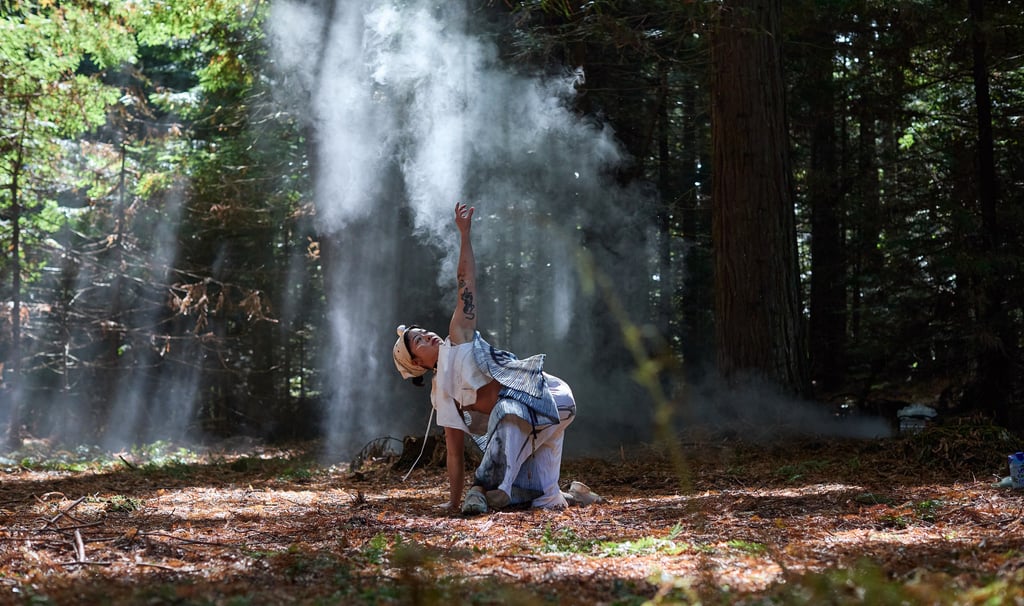
©️Mountains and Seas - Song of Today, Tash Tung, photo by Jamie Baker
Interviewer: Kassy Fang
Interviewee: Xie Rong, Daniel York Loh, and Beibei Wang
With Director and Designer Xie Rong
Q: Your visual language in Mountains and Seas – Song of Today brings together mythology and contemporary technology. How did the myths inspire the visual forms and the symbolic language you chose for this project? What new ideas or approaches did they spark for you as an artist?
A: The Classic of Mountains and Seas is a nationally and internationally known mythological fantasy. Its rich, imaginative world-building has inspired endless cultural productions in China, across Asia, and worldwide. So I made a very deliberate decision to step away from the grand magical fairytale and instead lean into something much more contemporary, rooted in the way we live today. We all use AI in some way, and we’ve all experienced light shows at festivals or clubs — but what excites me is combining elements that appear unrelated and letting them speak to each other.
I am an action artist; my work is rooted in Eastern philosophy and the Fluxus movement. It’s always about breaking boundaries and merging languages. Transformation is what matters. We had a very cinematic shoot on Box Hill this summer, the images feel like a faraway land, otherworldly, peaceful, almost timeless. Yet the laser element holds the narrative in a darker, more contained space. It becomes my live-painting ink, my response to the black box theatre. And Danni and Aolei, two extraordinary mixed-media artists, made this vision possible.
I imagined making Mountains and Seas with Beibei, she once came to my home for dinner with multi-instruments and began playing with chopsticks and rocks on the dining table. She is pure music: playful, instinctive, endlessly surprising. Working with her is like opening a door to another dimension. Daniel’s text is the soul of the play — poetic, sometimes satirical, sometimes funny, sometimes heart breaking — and his instinctive musicality gives the whole visual world a pulse.
We keep imagining how to carry Daniel’s message across different environments, so the piece has many possible futures, it could be performed in a park, a stately home, a museum, even a greenhouse. Light, AI, and live painting are simply tools to respond to each site, to shape atmosphere, to reveal meaning.
There are always plants and rocks in my installation work; the combination of body, nature, and action is at the centre of everything I do. I feel deeply honoured to work with such talented actors, dancers, and musicians. We are co-creating — listening, observing, shaping the work together. Watching Jennifer perform the text with such passion and precision is mesmerising, and our dancers Tash and Jiayi are so different yet work so powerfully together — contemporary, sensational, emotional, and brave.
One of my biggest learnings from this project is stepping into the role of producer and director, while also overseeing costume, set, lighting, and projection. It might seem like overload, but it feels very natural — artists often carry these roles already. I am learning every day, and I am grateful for a team who allow ideas to flow, transform, and trust me to hold the final vision. The power of teamwork is incredibly inspiring.
Q: The creatures in the piece form a symbolic ecosystem, from the phoenix and jade bird to hybrid beings. What drew you towards these particular forms? How do they continue your exploration of human identity, transformation, or migration in your work?
A: All the creatures in our play come directly from the original text, and what they share is that they are all multi-species beings. One key message in the Classic of Mountains and Seas is 化 — transformation. Written in the 4th century BCE, the text describes beings that merge male and female, human and plant, bird and fish. It is a world where identity is fluid and boundaries dissolve.
Daniel’s character is a lion who speaks all languages — across the animal kingdom and the human world. Daniel himself moves like this magical language-lion: he can rap, sing, roar, whisper, and shift emotional registers with complete natural instinct. His reflections on British nationalism also give the lion image deep contemporary layers.
Beibei embodies the creature we created for her — half animal, half bird, a guardian who can run and fly, existing between worlds. She introduced Songyuan, a phenomenal Beijing opera performer from Sweden, to the project. As a composer she carried a vision that only came alive when we were finally under the same roof. What Songyuan and Yuxiao brought into the room was utterly unique — something you can only feel live.
I asked each collaborator to think of a creature or myth from their own culture that resonated with them. Their roles grew from these conversations. Then I selected original Mountains and Seas creatures to shape their styling and presence. All my collaborators are writers, producers, directors — artists with deep histories of practice. So the creature they embody must honour the traditional text and reflect their own spirit, body, and artistic lineage. When you watch the play and then read their descriptions, you can feel how each creature becomes uniquely theirs.
I also live in a multicultural family. I have two half-Welsh sons; part of my family is in Australia, part in the U.S. Migration, mixing, and transformation are the texture of my everyday life. But the message of the play is simple: we are far more similar than we are different — a universe in oneness.
I imagine the play as my extended body — a space where my way of working with body, narrative, and gesture is carried by performers with different skills. Yet at its core, we are still exploring identity, humanity, transformation, and migration through movement, lighting, sound, and language.
Q: You take on the role of the painter, described as “an ancient root connecting the whole world of the piece.” How did inhabiting this figure shape the visuals and ideas? How does it reflect your artistic evolution?
A: One of my favourite writers and philosophers, Hélène Cixous, wrote: “I like to write like a painter and paint like a writer.” That line has always lived inside me. During our storytelling and sound workshop, Beibei said she sees music as a visual language, and Chenyuxiao wrote an ancient Tang Dynasty score that looked exactly like calligraphy writing and abstract painting.
These moments remind me how naturally different artforms speak to one another. In the 1960s, Western artists were deeply inspired by Eastern philosophy and the Fluxus movement was born. I have performed Cut Piece three times for Yoko Ono — she told me it is a music piece, and it truly is. John Cage’s 4'33” is the same: silence and emptiness becoming a visual score, a conceptual breath.
Yuxiao also reminded me of something ancient: in traditional Chinese culture, poets, painters, and musicians gathered in teahouses or wandered into forests together. They played guqin, danced by stream, composed poetry spontaneously. This was “happening” long before the Western Happening. In the West, artists were also scientists, engineers, biologists — always imagining, transforming, inventing.
In our play, my character is 后土 Hou Tu, an earth spirit. During our R&D and the Dorking shoot, I was creating the stage, making costumes, producing everything — so I didn’t yet know who or what I would become. After the shoot, our filmmaker said, “Have you heard Kate Bush’s Painter’s Link? You are the painter’s link.” And I thought: that’s it.
Inhabiting the painter helped me understand my role: I am the roots — connecting these magical creatures, holding the ground beneath them, offering space, nourishment, and trust so they can grow and thrive. It became less about performing my live painting and more like being a motherboard — a maternal grounding force holding the whole system together.
This reflects the evolution of my practice: moving from the individual body as canvas to a collective body, where gesture, sound, light, technology, narrative, and performers all become extensions of one living artwork.
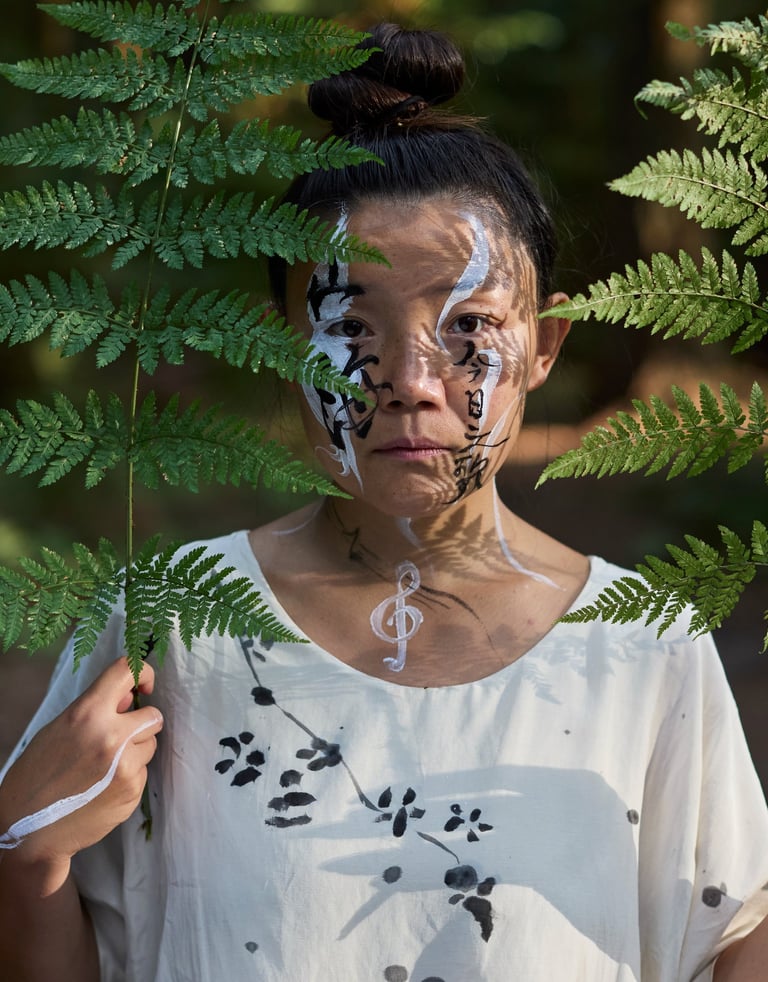
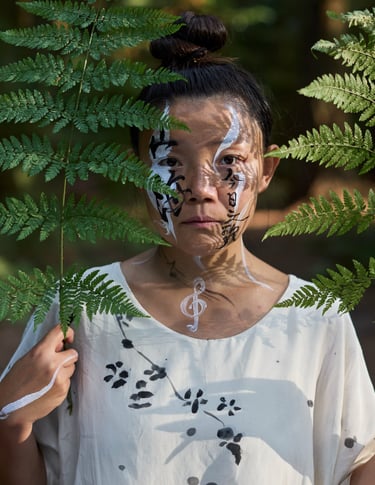
©️Mountains and Seas - Song of Today, Xie Rong, photo by Jamie Baker
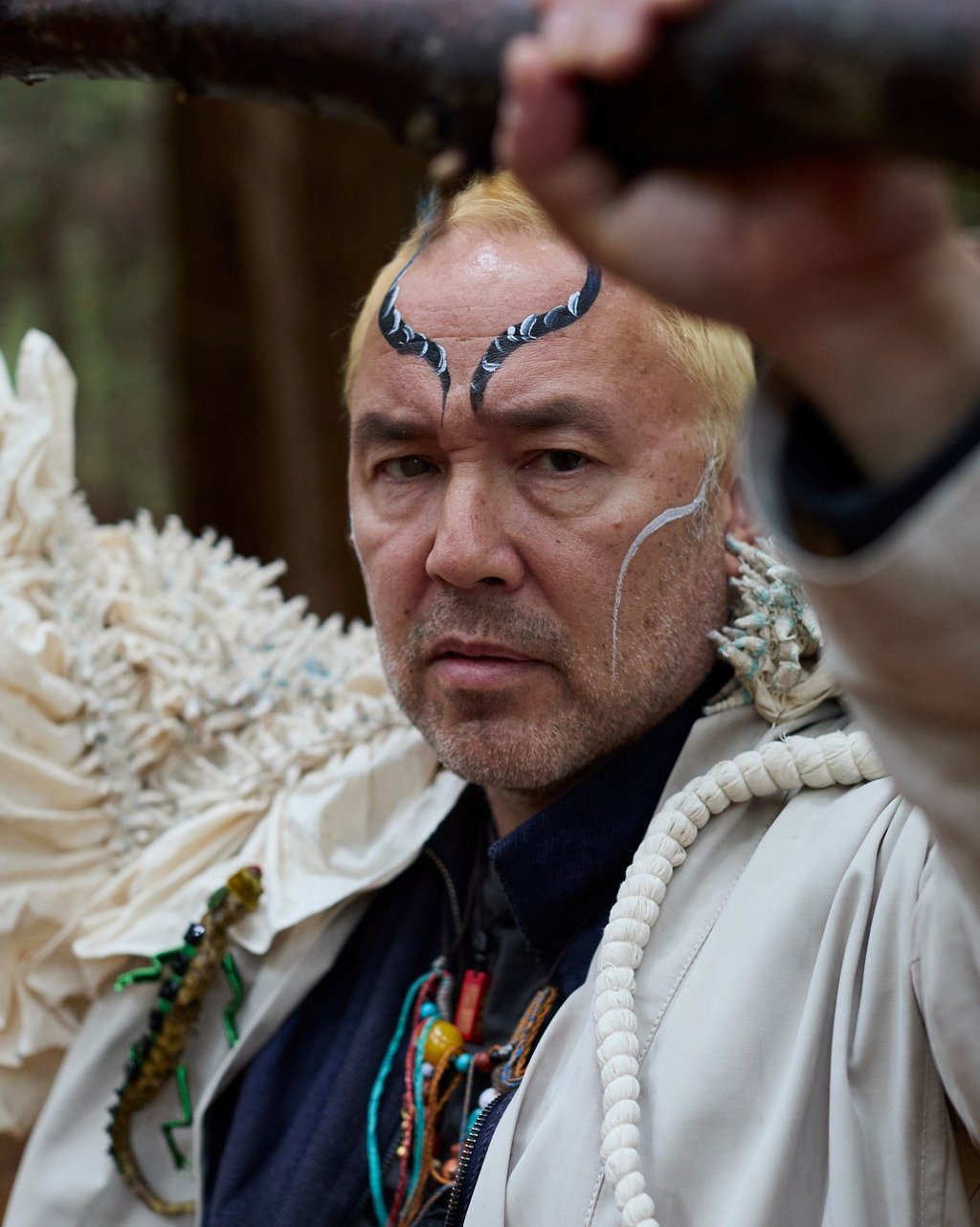
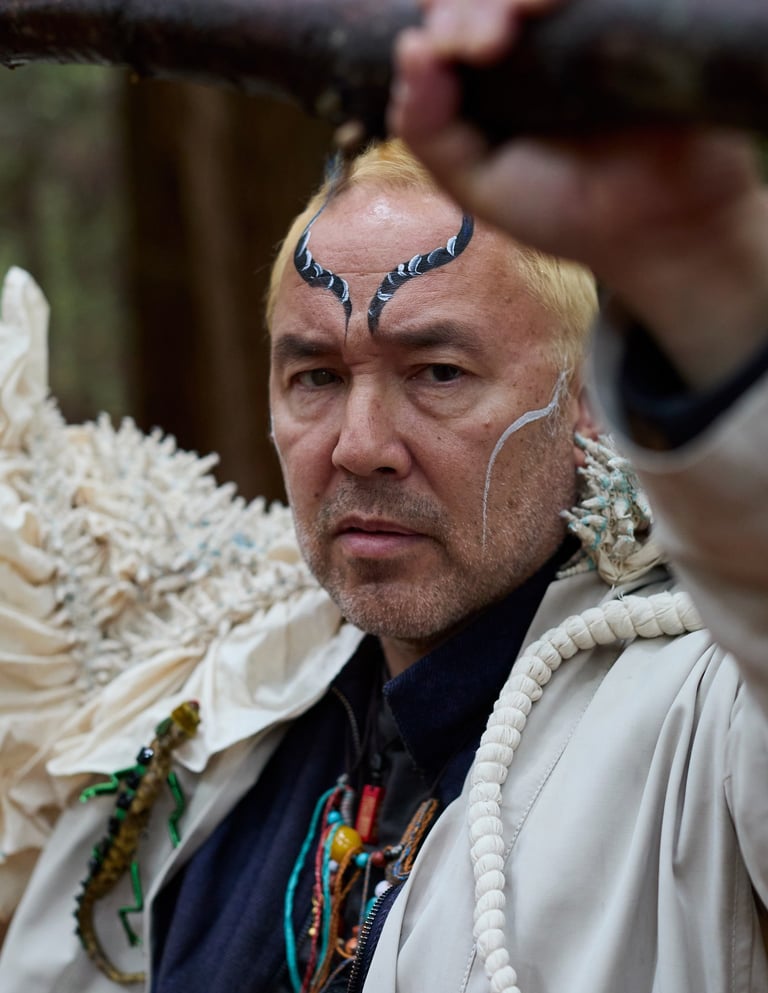
©️Mountains and Seas - Song of Today, Daniel York Loh, photo by Jamie Baker
With Writer and Actor Daniel York Loh
Q: Your script asks: “What if my art tears us apart?” How does this question continue threads in your writing about power, belonging, and political urgency? What challenges or opportunities did it present in shaping the piece?
A: There’s a quote by the writer James Baldwin: “The artists are here to disturb the peace”. Well, more and more these days, it feels like the artists are here to maintain the peace i.e. to reassure us that everything is fine, to manufacture consent. At the heart of our story is a Seeker – an ‘every-person’ who could be any one of us, searching for answers, faced with a world in crisis (I can’t remember a more feral and dangerous time).
In a jetlag fever dream, The Seeker attempts to find something ‘ancient’, something pure, a creature from the dawn of time, from the ancient world of what would be described as our ‘culture’ (those of us who could be described as being of ‘Chinese’ descent, but there’s parallels everywhere), to heal the world. The Seeker is very much an artist so it’s possible that they are creating, or searching for, that creature in art. But in a world where art is judged on how ‘clever’ it is, how ‘exotic’ (for people of Asian heritage) it is, how ‘pleasant’ it is, The Seeker can’t help asking that question: “What if what I create and show you is so profoundly and terrifyingly truthful, so incendiary, so powerful, that it rips a fragment in our consciousness?”
Who is programming and platforming work that could that now? Who is asking those big questions? Is this actually allowed? The notion of art as ‘healing’ is obviously lovely, and I think art can do that. But ‘healing’ could very easily become ‘pacifying’. So, yes, ‘power, belonging, and political urgency’ are most definitely in there. Those are three of the biggest concerns you could make art about. Those concerns are at the heart of so much great work and they’re at the very core of the human condition. People with power abuse people without power (this happens on the world stage, in occupied territories, in governments, in workplaces, in homes and in small ‘BESEA’ theatre companies), we all want to belong somewhere (even taking away the race context. And this is a time of fierce political urgency - I really don’t think we need to feel even slightly melodramatic about saying this.
Q: The work unfolds across fifteen fragments, moving between myth and the present day. In developing it, what kinds of collaborative ideas—across text, sound, movement, and visual elements—were you most excited to explore? How did these collaborations influence the direction of your writing?
A: Honestly, I’m so excited by all of it and beyond grateful I get an opportunity – and opportunities are harder and harder to come by in the current climate – to embrace all these elements with a room full of fantastic artists. I’m a ‘multi-form’ kind of person. I’ve acted on stage and screen and across many genres (classical theatre, new writing, experimental work, prime-time TV), I’ve played the guitar, I’ve directed plays and short films, even my writing goes across ‘straight’ plays, poetry, prose etc. Different elements catch me on different days and different moments. But when Jennifer is performing my text, Tash and Jia Yi are dancing, Beibei’s drumming, Yuxiao is playing the flute and Songyuan is reinventing Beijing Opera in front of my eyes – and all to Xie Rong (Echo)’s extraordinary designs and animations, it makes my pulse literally race.
Ultimately it all comes back to Xie Rong (Echo). We did a workshop on this with Kakilang Creative Lab participants back in 2024 and that kicked the whole thing off because Xie Rong began the workshop by reciting a poem by a murdered Palestinian writer (If I Must Die by Refaat Alareer) and then we made a whole workshop about climate change and activism inspired by The Classic of Mountains and Seas using cardboard boxes, paint and paper. That’s the kind of artist Xie Rong is. She can make art out of anything. The purest artist I’ve ever worked with. And it was that that really influenced the writing of Mountains and Seas – Song of Today 山海 · 今日之歌.
Q: The piece engages with urgent issues like climate crisis, activism, and rising global fascism. What do you hope audiences take away from experiencing these themes through your poetic, fragmentary approach, rather than through a more literal or argumentative lens?
A: To be honest, I have no ‘favourite’ genre or medium but with this I’m particularly fascinated hy the ‘album’ structure. There’s a Bruce Springsteen lyric, “We learned more from a three-minute record… than we ever learned in school”… and sometimes you do. There can be profound truths contained in short songs or poems or vignettes. I’ve always loved that idea of an album of songs that tell a different story in each song and those stories have characters inside them and, in the best work, those songs with characters and stories add up to something overarching that says something about our humanity – our needs, our hopes, our fears.
What I would like the audience to take away: I would hope the audience have a great evening. Yes, the subject matter is dark and we’re not flinching from that. But it’s very much a dance of defiance, there’s humour, there’s joy, there’s sass, there’s rap, there’s groove, there’s incredible music, fantastic performance, compelling animations, astonishing dancing and awe-inspiring visuals (on lo-fi budget). The audience should come away energised.
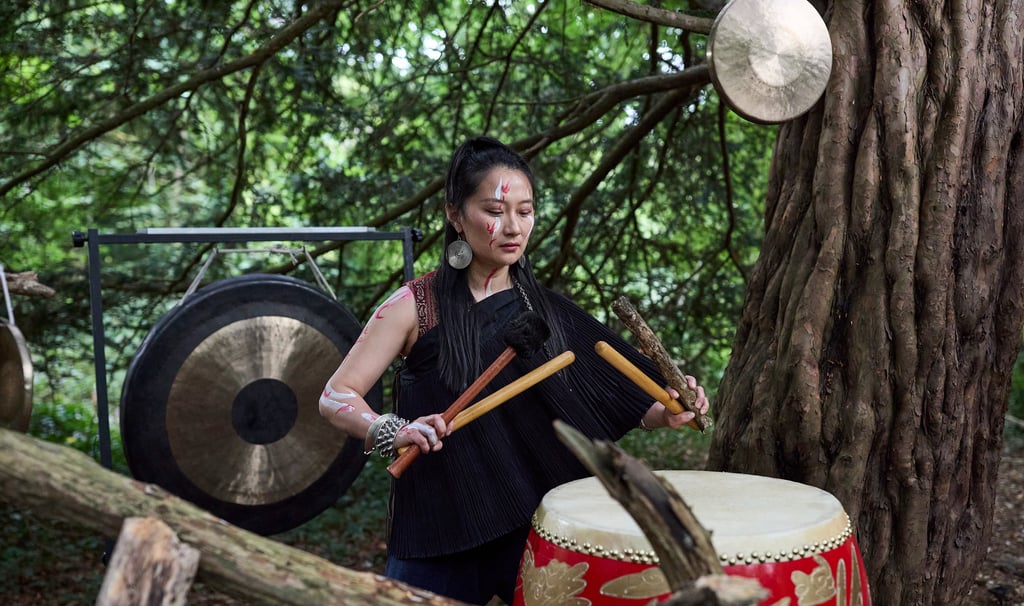
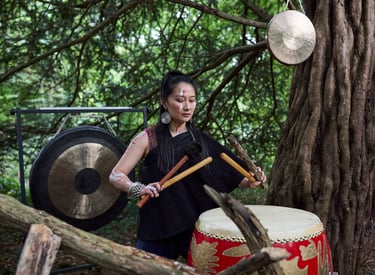
©️Mountains and Seas - Song of Today, Beibei Wang, photo by Jamie Baker
With Composer and Percussionist Beibei Wang
Q: How did the Five Elements shape the emotional and thematic arc of your sound-score?
A: I’ve always treated the Five Elements like a cosmic wiring diagram. My music-theatre work Five Elements from two years ago was a prelude. It taught me that metal, wood, water, fire, earth aren’t just symbols, they’re temperaments and impulses. I also try to avoid the word 'composing,' as it feels too formal for the way I make music. Coming from a percussionist and performing-artist background, all my work grows from playing. These Five Elements themselves are my instruments." For Mountains and Seas - Song of Today, the Five Elements became a philosophy for deconstructing classical musical logic.
Q: How did collaborating with Xie Rong and Daniel influence your composition?
A: Collaborating with Xie Rong and Daniel pushed me into territories I didn’t even know I was ready for.
After meeting Xie Rong, I became completely fascinated by her. I had never met someone so pure, so simple, yet intricate, profound, delicate and brave. And this bravery is a kind of intelligence that I think is very rare. Xie Rong is our director. I always joke that she’s like Chengdu hot pot paste: she’s from Chengdu, and she brings together all of us bits and bobs into the essence of the work. I’ve long admired John Cage and Fluxus and its playful boundary-dissolving spirit, and meeting Xie Rong was a nudge to step towards the path of an artist.
I also love theatre and I adore Daniel’s voice. It’s so ridiculously sexy. I was hypnotised. During the creative process, I kept looping recordings of his and Jennifer’s dialogue. At a certain point, I realised that the music almost felt unnecessary. Their voices were already so rich, so intense, so full of texture. That realisation changed how I made the music. In the final rehearsals I stripped away a lot of what I had been playing, leaving silence and space. In this way it is very East Asian in spirit. There must be room for imagination to breathe.
Q: What did you hope to evoke with music that ‘breathes’?
A: Breath is the invisible architecture around sound. In the section titled Meditation, I played with this idea.
I took a single plucked note from Songyuan’s guqin and reversed it, doubled it and played the two back together in my DAW. Suddenly it became something entirely new and almost electronic! It had a sense of vertigo, as if you were staring into an abyss. It was an accidental invention, inspired by breath itself: inhaling, exhaling.
Then I layered Songyuan’s Beijing Opera vocal line over it and the sense of space opened up completely. I love theatre, and I come from a background of traditional music education in China, which is inextricable from Chinese opera. Chinese opera itself is deeply connected to Chinese percussion, so for me it all connects naturally. That’s why I brought Songyuan and Yuxiao into this project. They are among the few professional young Chinese opera artists based in Europe but also are both unusually forward-looking and open in their approach to tradiConal arts. From a musical perspective, I imagine Songyuan as “Mountain” (⼭), Yuxiao as “Sea” (海), and Xie Rong, Daniel, and I as “Today / Now” (今) together forming the sonic landscape of Mountains and Seas – Song of Today.
I have to mention one of my favourite chapters: Echo Warrior. It’s rap, it’s hip-hop, it’s kuaibanshu 快板书 energy, and it interweaves the civil and martial worlds of Beijing Opera. In my mind, it’s two bands at once: a hip-hop/post-rock band rolling gritty beats, and a Beijing Opera percussion ensemble firing off luogujing 锣鼓经 patterns, including one of my favourite rhythmic figure called “choutou 抽头”. The bilingual dialogue, rap, and opera percussion contrast and collide. It’s thrilling because that collision is exactly my lived experience.
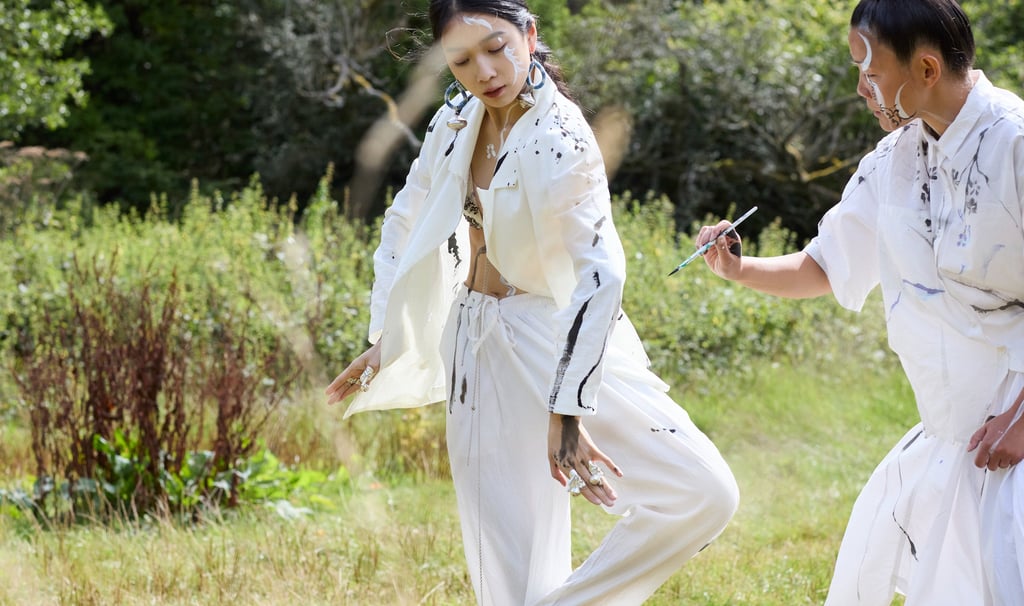
©️Mountains and Seas - Song of Today, Fan Jiayi + Xie Rong, photo by Jamie Baker
Listing information
Mountains and Seas – Song of Today 山海 · 今日之歌
Tuesday 2 December (preview) to Saturday 6 December
Omnibus Theatre, Clapham
1 Clapham Common North Side, London SW4 0QW
Booking at: https://www.omnibus-clapham.org/mountains-and-seas/#BookNow
Tickets: £10 (preview 2 December); £18/£16 concessions (3-6 December)
Tea Ceremonies
Tuesday 2 and Wednesday 3 December at 6.30pm
Free to ticket holders, no booking required
Sound Behind Curtain
A place for all Asian artists.
Your gift keeps the curtain rising for Asian creatives.
About
Contact
© 2026 Sound Behind Curtain. All rights reserved.
Terms & Conditions Privacy Policy