
REVIEW: Chiharu Shiota: Threads of Life
Review Date: 11th April 2026 @The Southbank Centre
REVIEWS
Kassy Fang
4/14/20262 min read
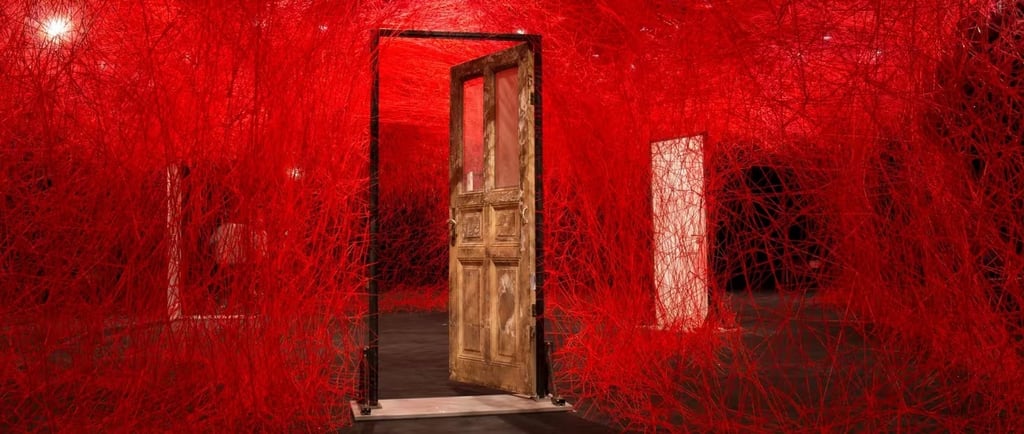
Chiharu Shiota, The Locked Room, 2016. Installation at KAAT Kanagawa Arts Theatre, Yokohama, Japan.
© DACS, London, 2025 and Chiharu Shiota. Photo by Masanobu Nishino and courtesy of the artist.
Chiharu Shiota’s exhibition Threads of Life runs alongside a new presentation by artist Yin Xiuzhen: Heart to Heart, known for working with recycled fabrics and everyday materials to explore memory, migration, and lived experience. The proximity of the two creates a subtle tension, their shared materials leading to different emotional registers, one more contained, the other more immersive.
Walking onto the upper floor, the sound of heartbeats draws you in before the works come into view. In the first gallery, Shiota’s signature red thread installations extend from floor to ceiling, weaving around rusted keys suspended in space. In a separate room, threads pierce and suspend handwritten letters, many carrying messages of gratitude. Nearby are earlier works, including mixed-media collages and photographic documentation of performances made during her period of study with Marina Abramović.
The final gallery presents During Sleep (2026). Ten hospital-style steel-framed beds are enclosed within layers of black thread, forming cocoon-like structures. During my visit, a live performance was taking place: all of the beds were occupied by sleeping performers. Their bodies were mostly concealed, with only small traces visible through the threads, a strand of hair, a fragment of skin, just enough to suggest differences in age and gender.
The room held a restrained stillness, though not complete silence. Visitors lowered their voices, adjusting their behaviour to the conditions of the work. A sense of unease spread through the space. People watched, hesitated, tried to make sense of what was in front of them. Were they comfortable? Did the brightness of the lights disturb their rest? I became increasingly conscious of my own movements, the soft but noticeable sound of my footsteps on the wooden floor interrupting the stillness. Questions moved among the audience, often directed to staff, about how the performers entered or left, or how long they remained inside.
Outside the performance, the beds remain. The sheets and duvets hold their shape, as if preserving the presence of bodies that have just left. They resemble shells, containing the trace of something no longer there. The work gives form to memory, dreams, and imagination, producing an uncanny sense of presence without a body. At the same time, there is a sense that the visual language risks becoming too familiar, the cocoon, the trace, the suspended object, recurring motifs that are immediately legible, perhaps too easily so.
The wall text explains that the work connects to Shiota’s experience of frequently moving after relocating to Germany. Each new place of sleep brought a moment of disorientation on waking, a brief inability to recognise where she was. Weaving becomes a way to construct a sense of place, something stable and personal. She has spoken about her interest in the shapes left behind, the imprint in bedsheets, the trace of a body. Sleep exists in a state between waking and dreaming. She writes, “To me, death might be the perfect sleep. It represents a new state of existence within the cycle of life, one that moves towards a larger universe.”
What remains less certain is how far this experience can be shared. The work invites empathy, but also positions the viewer at a distance, looking in, speculating, projecting. Does the work open a space for reflection, or does it aestheticise vulnerability into something too controlled and too composed?
★★★
For more information about Chiharu Shiota: Threads of Life, please visit: https://www.southbankcentre.co.uk/whats-on/chiharu-shiota-threads-of-life/
Sound Behind Curtain
A place for all Asian artists.
Your gift keeps the curtain rising for Asian creatives.
About
Contact
© 2026 Sound Behind Curtain. All rights reserved.
Terms & Conditions Privacy Policy