
REVIEW: Dialectics of Erasure
Review Date: 1st May 2026@Theatre Deli
REVIEWS
Kassy Fang
5/4/20263 min read
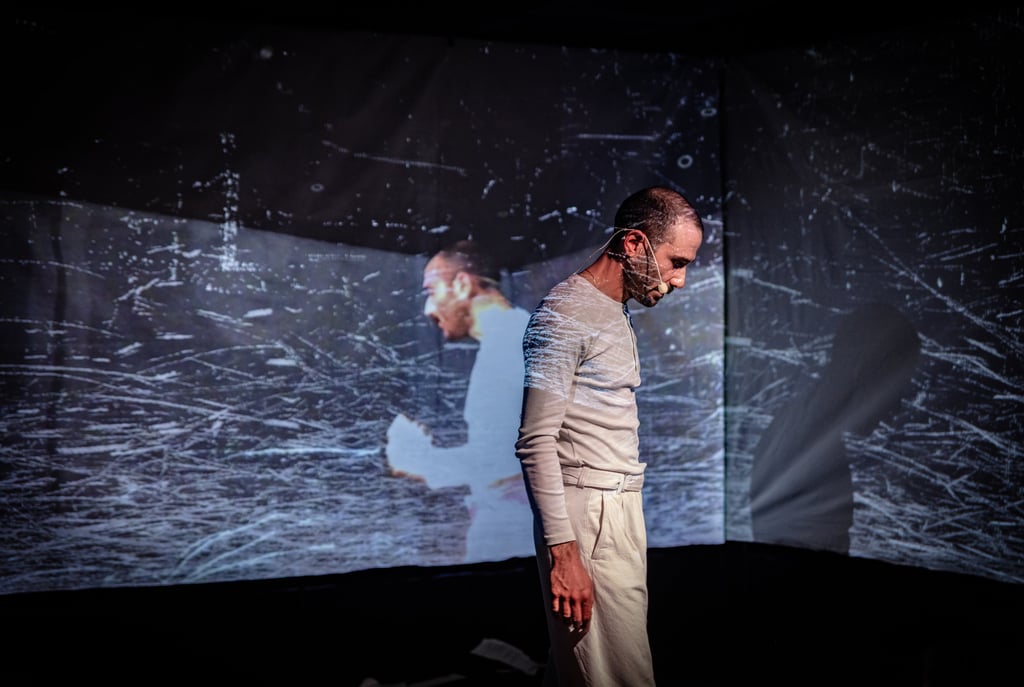
©️Amy-Rose Edlyn of Bold Mellon Collective
Dialectics of Erasure, a participatory lecture-performance by Palestinian-German artist-scholar Mudar Al-Khufash, unfolds as both testimony and provocation. Produced by Emilia Nurmukhamet with Bold Mellon Collective and dramaturgy by Dani Abulhawa, the work invites its audience into the mechanisms that sustain the everyday performance of settler colonialism.
Before the performance begins, the audience gathers in a public outdoor space for a guided banner-making activity. Through a collective vote, the phrase “when people are occupied, resistance is justified” is chosen. Carrying the banner towards Theatre Deli, what might have remained a symbolic gesture is suddenly interrupted. A passerby rushes in and tries to tear it apart. Only a small piece is taken, and the message remains readable. “Everyone, hold what’s left with pride,” someone calls out. The short walk becomes, unexpectedly yet inevitably, a demonstration.
Inside the theatre, the disruption continues. Minutes into the performance, there is a knock at the door. Police are making enquiries. These intrusions mirror the work’s central concerns with unsettling clarity. The language of “safety concerns” and “political sensitivity” reveals itself not as neutral precaution but as a mechanism through which erasure is enacted, and voices are curtailed. What happens onstage is not abstract. It is ongoing.
Al-Khufash opens with a poetic and personal account of documented instances across the UK where Palestinian cultural expression has been obstructed or refused. Dressed entirely in white, his body becomes a surface for projection. Projections scenography is designed by Liudmila Siewerski with projection mapping by Nurul Wardani and Sammy Kissin of Slice of Light, the three-screen visual field spills onto him, at times partially and at times completely obscuring him. The imagery loops fragments from the earlier banner-making, alongside shifting terrains such as oceans, rivers, and unstable land formations, as well as anonymous black and white family photographs. Sound encroaches in parallel. The distant hum of drones intensifies into an oppressive presence.
One of the most affecting moments draws from Azza El-Hassan’s documentary King and Extras. The film traces a journey across Palestine, Jordan, Syria, and Lebanon in search of the lost archive of the Palestine Liberation Organisation, missing since the 1982 invasion of Beirut. In a brief excerpt, a Palestinian refugee mother is asked, “What is your role?” She answers, “When planes pass, I lie down and pretend to be dead.” From this, Al-Khufash poses a question that reverberates through the work. What does it mean to perform Palestine?
The performance weaves in theoretical frameworks. Drawing on the idea of “imposed temporality,” articulated by Lewis R. Gordon, colonialism is framed not only as the seizure of land but also of time itself. Equally central is the concept of the repertoire, developed by Diana Taylor. This refers to embodied memory carried through gesture, speech, song, and ritual. Forms of knowledge that persist through live transmission and resist destruction. Against erasure, the repertoire remains.
Throughout, Al-Khufash holds a thick catalogue that reads as script, archive, and testimony combined. Near the end, he begins tearing out its pages one by one. They fall to the ground and are then swept away in a sequence of movements directed by Rudzani Moleya. The gesture is stark. A physical enactment of erasure that echoes both the work’s title and the conditions surrounding its presentation.
The performance moves between the personal and the collective, the intimate and the theoretical. Time fractures and folds. What takes place is both immediate and already repeated, a journey occurring now and countless times before.
What constitutes an act? What distinguishes performance from reality?
If existence itself becomes resistance, then in the current global climate, where right-wing politics continue to shape the conditions of speech and visibility, this work insists on the urgency of retelling and witnessing again and again across perspectives and bodies. Not as repetition, but as necessity.
★★★★
For more information about Dialectics of Erasure with Mudar Al-Khufash & Bold Mellon Collective, please visit: https://www.theatredeli.co.uk/Event/enddatedialectics-of-erasure-with-mudar-al-khufash-bold-mellon-collective
Credits
Artistic Director, Writer, Performer: Mudar Al-Khufash
Production: Emilia Nurmukhamet, Bold Mellon Collective
Projections scenography Design: Liudmila Siewerski
Projection mapping: Nurul Wardani and Sammy Kissin of Slice of Light
Dramaturgy: Dani Abulhawa
Movement Direction: Rudzani Moleya
Well-Being Support: Lubna Hoque
Technical Stage Management: Ghost Chan
Marketing: Dear Annie
Captions: Rachel Sampley
Sound Behind Curtain
A place for all Asian artists.
Your gift keeps the curtain rising for Asian creatives.
About
Contact
© 2026 Sound Behind Curtain. All rights reserved.
Terms & Conditions Privacy Policy