
REVIEW: Hot Pot
Review Date: 17th June 2026 @Playhouse East
REVIEWS
Burong Zeng
6/20/20264 min read
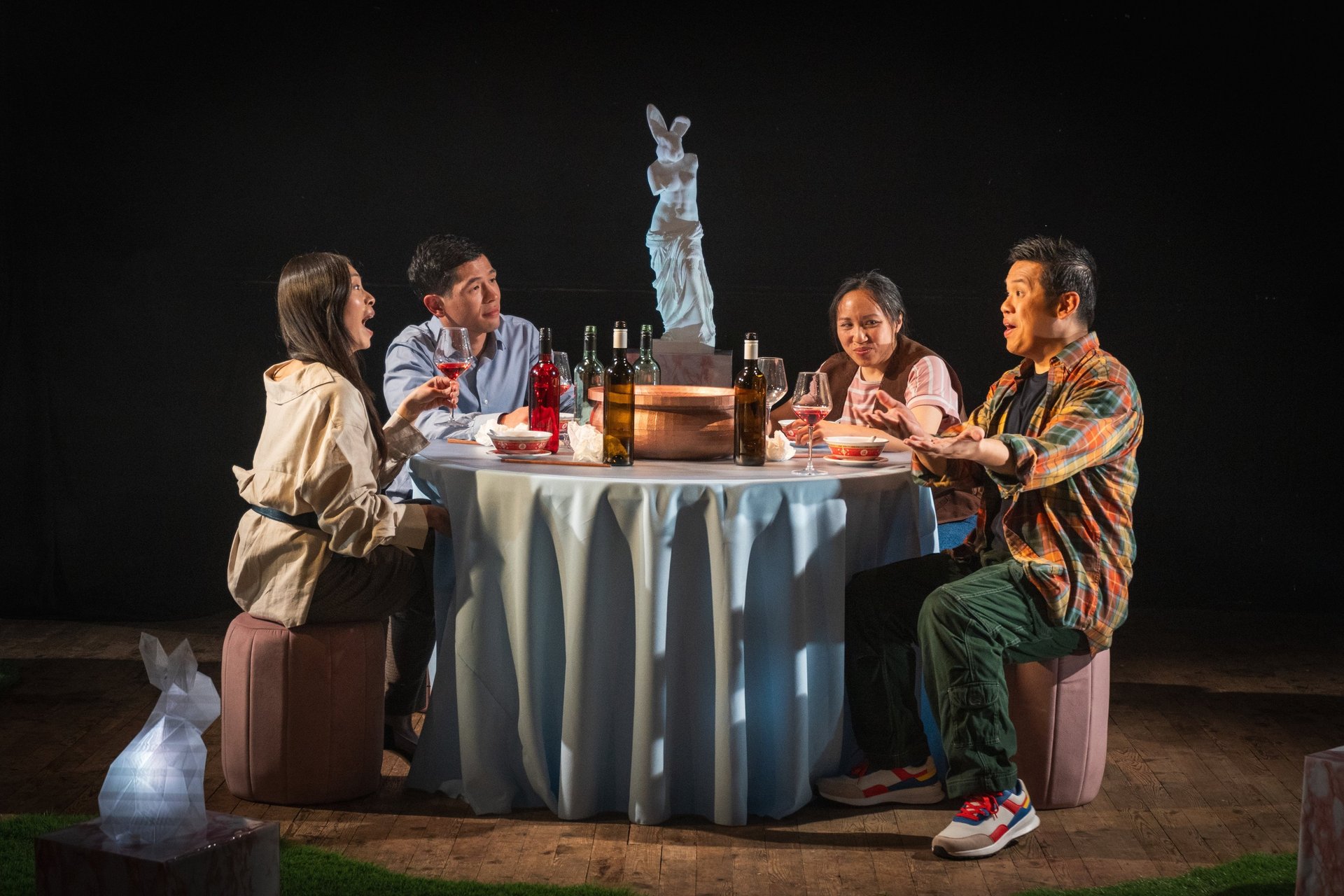
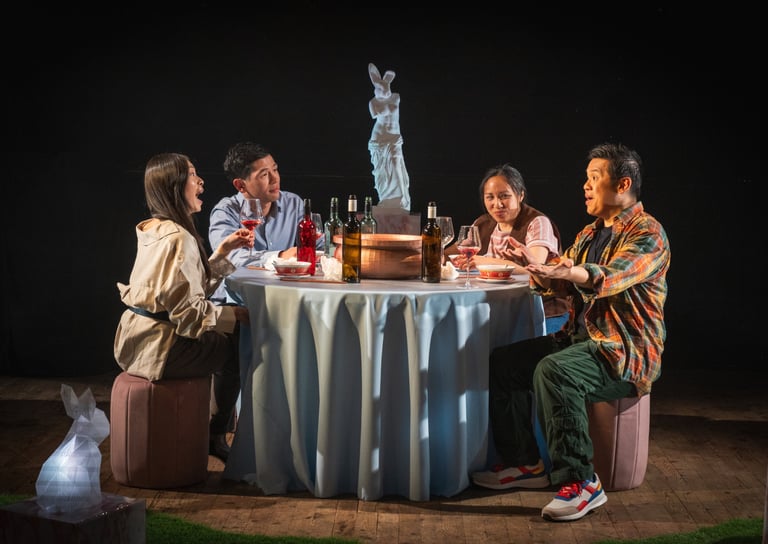
Four friends from university, Tao, Ming, Lin and Mei, sit down to a hot pot dinner to mark twenty years since graduation. It is warm as a reunion, and longer still as a farewell. Hot Pot, premiering at Playhouse East’s WIP Festival, is the debut production by Auka Productions, directed by Namoo Chae Lee and written by Hongwei Bao. The play began life as a short story, Reunion, also written by Bao in 2022 as a work of East Asian queer literature, then grew directly out of watching “freedom” become the most contested word of the COVID-19 pandemic across the UK and East Asia, where the four characters reside. References to the pandemic, such as herd immunity and the Stop Asian Hate movement in the UK, are scattered throughout the play, not as background colour but as the mechanism that makes the friends’ intense longing for in-person connection feel relatable for many audiences.
Struan Davidson and Windson Liong, founders of Auka, play Ming and Tao, the pair whose intimate relationship was folded up and pocketed as undergraduates, when the stakes of coming out were too high in East Asia. Their closest friends at university, Lin (Michelle Yim) and Mei (Shin-Fei Chen), run a parallel version of this argument without the romantic charge. They organised feminist campaigns together as students and dreamed of futures beyond motherhood, though Mei has since felt the pressure to perform a particular kind of success for women: a career and a family. As journalism students, all four were bound by a shared devotion to their teacher and icon, Professor Feng, who never appears on stage but recurs constantly as a topic of conversation at the table. Her exile story and absence lend real weight to the choices the four have made.
The play centres on the inner struggle they share. Whatever each of them pursued, they have spent two decades either practising, struggling against, or abandoning the instinct to tell the truth, and it haunts them despite their different, even contradictory, life choices. Ming and Mei have each married into a privileged family to help their careers, while Lin and Tao keep pursuing the more precarious version of an authentic life, writing queer literature or living as artists. Tao’s return from London sets up the rare chance of this reunion, and also the clear-eyed realisation that a full reunion is not really possible, because their lives have already diverged too far to fully meet again.
Each performer shows great capacity to gradually reveal the unsaid struggle beneath what they withhold. Davidson plays Ming’s repression as exhaustion rather than control. Chen plays Mei’s composure as a performance within the performance, a magazine editor's polish that she keeps maintaining among old friends, so that the moments it does crack read as armour finally giving way. Liong and Yim, as Tao and Lin, both resist playing the “authentic life” as enviable: neither lets freedom look weightless, playing its costs: precarity and the daily work of staying chosen, as visibly as its relief.
The staging stays spare throughout, with the dining table, four stools, and the huge pot itself. Just behind the table and slightly out of the four friends’ eyeline, a Rabbit God statue presides over the meal like a household shrine. Tao tells the audience why, in his monologue at the start of the play, the Rabbit God descends from a Qing-dynasty tale about a low-ranking clerk named Hu Tianbao, who was executed for desiring a senior official and posthumously deified in the underworld as patron of male same-sex love, in recompense for that unjust death. Placing the Rabbit God statue at the head of the table does some of the play’s argument before anyone speaks - queerness here is not an import but an inheritance, sitting quietly at the family meal long before any of these four friends were born. Smaller rabbit lanterns sit around the edges of the stage, glowing quietly through the whole performance, neither set dressing nor special effect, so much as a second audience, witnesses who, like us, sit at the margins of the reunion and watch it happen.
The production doesn’t lean heavily on sound, but lighting works effectively to hold three different spaces together, moving between the four old friends’ student years, the present-day hot pot table, and Tao’s inner monologue, employing a stream of consciousness rather than discrete, walled-off flashback scenes. The past is never allowed to feel safe over; it keeps pressing into the present-day reunion rather than sitting behind it.
That second leaving, not the reunion itself, is where Hot Pot’s strength lies, carried by a solid script and layered performances. Its particular flavour is bittersweet: the warm, communal meal of the East Asian table becomes the setting for a slow-burning realisation of the impossibility of going back.
Although an idealised picture of university journalism studies, and a portrayal of single womanhood through Lin, can feel a little static at times, the whole play flows very well throughout and treats each of its four characters with real warmth and empathy. Hot Pot succeeded in genuinely presenting stories of East Asian queer and diasporic life after 2020 that have been rarely told, achieved through the tenderness and intimacy of queer love and friendship. It is exactly the kind of voice that needs to be heard far more often.
★★★★
For more information, please visit: https://www.aukaproductions.com/whatson
Credits
Playwright: Hongwei Bao
Producing Company: Auka Productions
Director: Namoo Chae Lee
Dramaturg: Ang Xiao Ting
Movement Director: Suyoung Park
Set & Costume Designer: TK Hay
Lighting Designer: Brett Kasza
Sound Designer: Paul Castles
Stage Manager: Eddie Latter
Cast: Shin-Fei Chen / Struan Davidson / Windson Liong / Michelle Yim
©️ Photo by Brett Kasza
Sound Behind Curtain
A place for all Asian artists.
Your gift keeps the curtain rising for Asian creatives.
About
Contact
© 2026 Sound Behind Curtain. All rights reserved.
Terms & Conditions Privacy Policy