
REVIEW: Led By The Wind
Review Date: 4th July @ACT Theatre Studio
REVIEWS
Burong Zeng
7/8/20264 min read
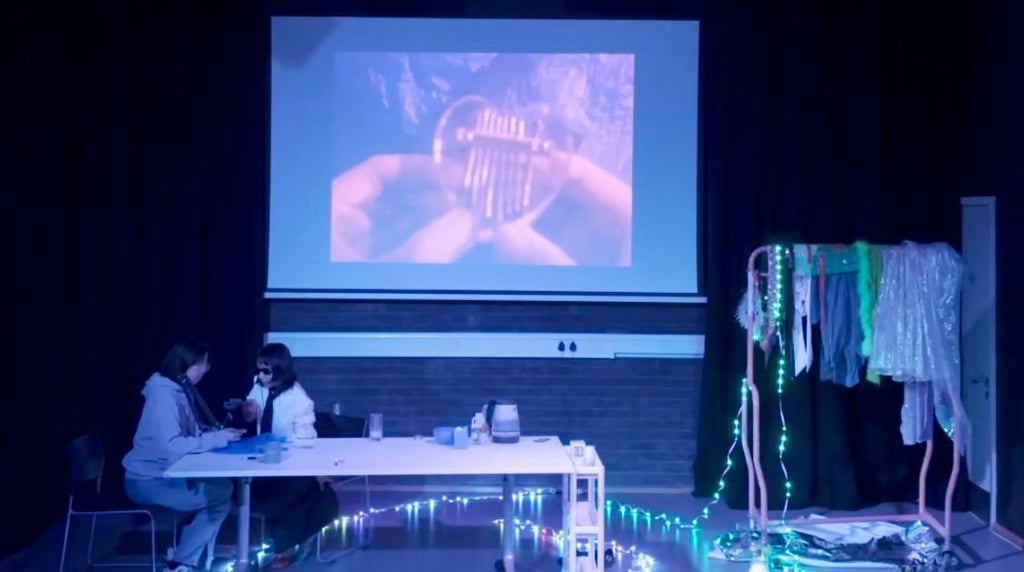
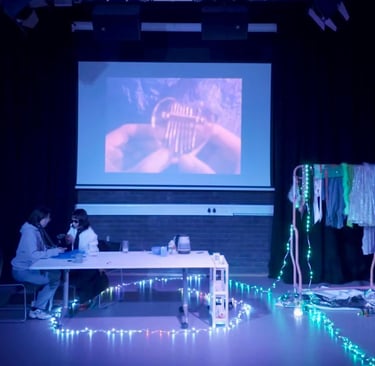
©️ Photo by Ziyi Wang
What if the existence of a river is true, but the hometown is forgotten? The new iteration of Led By The Wind, directed by Kiki Fanjin Ye and delivered by the devised theatre collective Ensemble Not Found, shows us an intimate epic of self-discovery and self-acceptance through a dreamlike audio-visual journey, following a queer woman tracing a river upstream in search of her forgotten hometown.
The anonymous character 'she', played by Lanyun Huang (Finch), exists somewhere between nightmare and dream, unable to tell whether she is awake or asleep. Trapped in what feels like a dark room with black windows, she is awakened at 3 am by a mysterious bartender named Windy (Han Gao), whose surreal appearance - a black bob, sunglasses, monochrome suit and mismatched slippers - immediately signals that she belongs to a space beyond reality. Windy possesses an uncanny ability to hear 'her' unspoken thoughts, establishing an intimacy that words alone cannot achieve. Dressing one another in luminous fabrics, dancing, making vivid green drinks, watching home videos and venturing into the sea, Windy gently guides 'she' towards forgotten memories of home. As she learns to swim, memories of her hometown gradually resurface: the river, the taste of familiar tea and, finally, the name of the place she thought she had lost. By the time the two sit together watching blurred footage of a playground that could belong to anywhere, home is no longer defined by geography but by a renewed sense of connection and belonging. The darkness that once confined her has quietly dissolved.
Led By The Wind excels in incorporating multiple media. The projected videos could stand alone as a moving image work, with recordings by the two performers of their daily lives, with visual effects, and with live recording of the performance happening on site. Most strikingly, each chapter of the play opens with a quietly poetic, dreamlike title, like 'river', 'water', 'seaside', '200 years later', with an animation of a winding river made of each chapter's name flowing across the wall, constantly reminding us that the river is real: not a physical river in its geographic specification, but a river of words, of consciousness, that leaks into and finds its way through. It is a memory that resists fading, for people who might feel rootless, lonely and displaced. Sound works really well with the visual imagery to create the atmosphere of each chapter. The show also involves live sound in the Seaside chapter, where Windy and she create the sound of the beach, of crackling sand rubbing against the skin, and a wuthering sound at the seaside, through an amp, a recorder and fabrics that carry water's quality.
Costumes are shimmering and playful throughout the show, and mark the distinctive characters of the two queer women: she is dressed casually in a light grey hoody, jeans and sports shoes, in contrast with Windy's surrealistic look. But after a scene where they dress each other up and do a playful catwalk and dance, she loosens up and embraces the colours by wearing the fabric. Huang's persona changes through the show, from heaviness, self-guardedness and hypervigilance to something relaxed, playful and light, a shift carried almost entirely through her body language. Gao's Windy, by contrast, is built mainly through effective costume. Neither is a theatre-trained performer; both are visual artists themselves, and carry themselves comfortably on stage, which is also part of the director's devising choice.
The lighting is composed of tinted blue backlights for atmosphere, colour lighting strips that look like a Milky Way surrounding the table and a clothes rail on stage, and a glass jar of twinkling star-like lights, which they take out and place around the Milky Way while chatting. There are many stunning visuals created throughout the show, and it is a clear directorial decision to embrace a rich language of moving image, live sound, prerecorded materials, projection and mobilised lighting. It is also a clear decision to play with the dialogue between spoken words and prerecorded dialogue, as Windy shows at the beginning with her superpower of hearing the inner voices of others. Playing their dialogue in two layers enriches the play: what has been said, and what has been felt through telepathy, showing us what queer intimacy feels like.
In a few sections, it could feel slightly overwhelming, with many media playing out at the same time, and with two languages (Mandarin and English) mixed, alongside subtitles in the projected video, particularly for non-Mandarin speakers. However, the adventure felt very relatable and accessible throughout, with a clear theme: the odyssey of a queer woman trying to find her identity, retrieve her memory, and eventually make peace with herself. The show invites audiences into a sensory experience where nostalgia and displacement intertwine. At its heart, it reflects on how East and Southeast Asian queer women in London navigate identity, community and belonging across geographies. The ending returns to her dream at the very beginning, closing a circular loop of her journey.
The show gives a structure into which intimate materials, whether improvised dialogue or recordings or home videos, can be added, allowing it to continue growing into different versions. That is a true asset for a devised theatre piece, creating a structure that invites different performers to fill it in. A first-generation ESEA queer woman's odyssey of self-discovery has not been a topic often shown on stage. She seems all alone, yet her inner journey is rich and embraces fluidity in all its manifestations.
★★★★
For more information, please visit: https://creativeyouthcharity.org/event/led-by-the-wind/
Cast and Creatives
Director & Playwright: Kiki Fanjin Ye
Dramaturg: Nefeli Kentoni
Cast: Han Gao, Lanyun Huang (Finch)
Scenography & Costume Designer: Xinyu Xu
Movement Director & Stage Manager: Xiaonan Wang
Sound Designer: Jovienne Jin
Videographer: He Zhang
Lighting Designer: Vivi Wei
Produced by Ensemble Not Found
Sound Behind Curtain
A place for all Asian artists.
Your gift keeps the curtain rising for Asian creatives.
About
Contact
© 2026 Sound Behind Curtain. All rights reserved.
Terms & Conditions Privacy Policy