
REVIEW: REMIX - This Time the Voice Is OURS!
Review Date: 4th Feb 2026 @LSO St Luke’s
REVIEWS
Zoe Yingying Xie
2/7/20264 min read
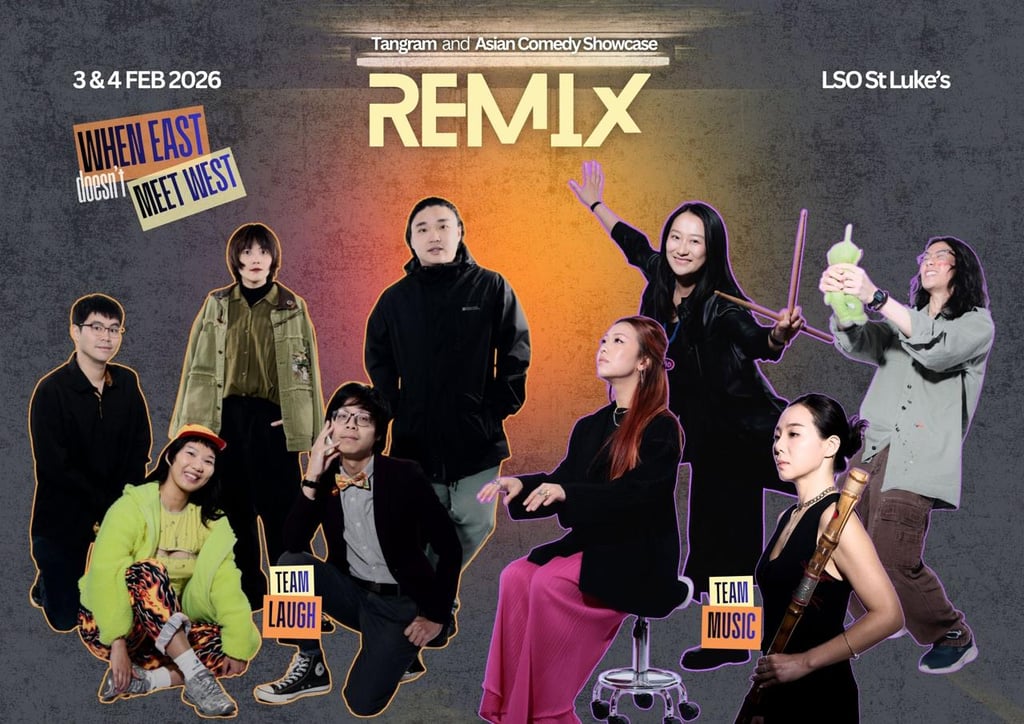
©️Tangram REMIX
When I first heard about REMIX, I wasn’t entirely convinced. A showcase combining contemporary music and stand-up comedy around Chinese culture could easily fall into disconnected fragments or shallow gestures. But Tangram and the London Symphony Orchestra delivered a bold and tightly framed evening that was both emotionally charged and sharply aware of its form and politics.
The programme opened with Chinese Overture (Carl Maria von Weber, arr. Alex Ho), performed by pianist Junyan Chen, daegeum player Dasom Baek and percussionist Beibei Wang. The piece is often cited as one of the earliest examples of Western classical music using a Chinese folk melody, but it is also a textbook case of Orientalist imagination. Weber never visited China nor studied Chinese culture. He found the tune in Rousseau’s 1768 Dictionnaire de Musique and used it to evoke a distant and exotic China. The fact that this work was reinterpreted by East Asian musicians on a London stage made its return feel both poetic and pointed.
This thread continued with Signore, Ascolta! (Giacomo Puccini, arr. Alex Ho), shifting focus to the character of Liù. Like Butterfly in Puccini’s Madama Butterfly, Liù belongs to a long lineage of submissive East Asian women written for Western consumption. They exist only to serve, suffer and die beautifully. That such narratives continue to be performed by major opera houses today is not just a matter of heritage, but also of exclusion. REMIX didn’t reject these works. It turned them inside out, asking us to listen again with different ears.
The tone then moved toward more direct expressions of contemporary voice. Nothingness (Dasom Baek), inspired by a Korean death ritual, layered textures until they dissolved, turning absence into a compositional gesture. BLINKER (Alex Tay, text by Alex Tay and Enyuan Khong) was the most explosive moment of the night. Using satire and theatrical confrontation, the piece dissected a racist line from Virginia Woolf and expanded it into a surreal face-off between the author and her own words. The performance culminated in a tense and vulnerable moment of personal testimony. It was the most emotionally charged and high-risk segment of the evening.
Pagodes (Claude Debussy), performed by Junyan Chen, was heard differently in this context. The beauty of the piece does not come from understanding, but from distance. Debussy’s impression of Javanese gamelan was transformed through layers of aesthetic filters into bell-like harmonies and floating rhythms. This was not a neutral homage. It was a reflection of how sound can be shaped by the eye that listens.
Modul 5 (Nik Bärtsch, arr. Rockey Sun Keting) offered quiet discipline. The trio moved together through tight repetitions and shifts in pulse. In contrast, Invisible (Dasom Baek) traced subtle sonic landscapes, while Dari (Dasom Baek) invited the daegeum and piano to meet each other halfway, not in opposition but in shared space.
The Firecracker sequence (Martin Denny, Yellow Magic Orchestra, Jennifer Lopez, arr. Rockey Sun Keting) mapped how Orientalist sound survives and evolves. From exotic lounge music to Japanese synth pop to global dance charts, the same motifs were lifted, stylised and resold. Here, the music became an archive of how culture travels and erases.
The closing work, Credo in Credo (Beibei Wang), returned us to the present. The score included not only structured playing from percussion, daegeum and piano, but also real-world sound clips, like the call of a street fish vendor. Rather than creating chaos, Wang shaped these textures into a living soundscape. The music was not just about commentary. It was about listening to the world as it is.
All three musicians brought distinct power to the stage. Beibei Wang’s percussion was full of impact and vitality. Dasom Baek’s daegeum playing was expressive and emotionally precise, especially in moments of theatrical intensity. Junyan Chen’s piano was elegant and clear, yet full of intention and energy. Together, they built a language of breath, rhythm and resistance.
The comedians were not comic relief. They were a parallel line of critique. Sam See was an excellent host, delivering clear and compelling links between pieces. Blank Peng’s set was built on honesty and boldness, with brilliant reversals that kept the audience alert. Jen Zheng shared her divorce story with startling depth and invited us into real documents and lasting questions. Jinhao Li was a true deadpan technician. His short-form jokes landed with clean precision. Ken Cheng, closing the evening, brought the most grounded stage presence and delivered sharp, clever and spontaneous commentary with ease.
If the show had any weakness, it came from the transitions. A few moments between music and comedy felt slightly hesitant. The visual design also leaned too literally. Projected imagery tried too hard to explain what the music already said. A more abstract lighting approach might have offered stronger aesthetic depth. Still, these were minor issues in an ambitious and high-stakes production. REMIX didn’t try to resolve cultural contradictions. It gave space to artists who live them, speak them and shape them through their own tools.
The power of REMIX lies not in offering conclusions but in shifting the angle of the questions. It shows that humour can be a tool for critique, satire can be an act of care, and rewriting the canon is not about destroying tradition, but about making room for new names. That night, we heard voices that had been extracted, and we saw clearly who now holds the right to tell the story.
★★★★
For more information, please visit: https://www.lso.co.uk/whats-on/tangram-and-asian-comedy-showcase-remix/
Cast & Creatives
Percussionist: Beibei Wang
Pianist: Junyan Chen
Daegeum player: Dasom Baek
Mezzo-soprano: Hannah Dienes-Williams
Presenter, Comedian: Sam See
Comedian: Ken Cheng, Blank Peng, Jinhao Li, Jen Zheng
Directed by Alex Ho and Rockey Sun Keting
Chinese Overture: Carl Maria von Weber
Nothingness: Dasom Baek
Estampes – I. Pagodes: Claude Debussy
Music from Turandot: Giacomo Puccini
Credo in Credo (world premiere): Beibei Wang
Modul 5 : Nik Bärtsch
Firecracker: Martin Denny / Yellow Magic Orchestra
다리 (Dari) (world premiere): Dasom Baek
BLINKER (world premiere): Alex Tay
About Tangram: Tangram is an artist collective specialising in multidisciplinary and cross-cultural productions. Their work builds on a foundation of contemporary classical music, drawing out its capacity for storytelling by interweaving design, movement, text, film, visual installation and performance art. Nominated for the Royal Philharmonic Society’s Young Artist Award 2023 for being ‘truly innovative’, Tangram projects have ranged from collaborations with Chinese sword dance and Chinese opera masters, programmes of music made for stones, ice blocks and plastic bags, and performances with live action painting and audience participation.
Sound Behind Curtain
A place for all Asian artists.
Your gift keeps the curtain rising for Asian creatives.
About
Contact
© 2026 Sound Behind Curtain. All rights reserved.
Terms & Conditions Privacy Policy