
REVIEW: Second Trimester
Review Date: 22 April 2026 @Battersea Arts Centre
REVIEWS
Kassy Fang
4/24/20263 min read
★★★★
For more information about Second Trimester, please visit: https://bac.org.uk/whats-on/second-trimester/
Credits
Lead Artist & Writer: Krishna Istha (he/they)
Performer & Co-Creator: Geetha Shankar (she/her)
Director: Milli Bhatia (she/her)
Creative Producer: Ruby Glaskin (she/her)
Set & Costume Designer: Ting – Huan 挺歡 Christeene Urquhart (she/her)
Lighting Designer: Joshua Gadsby
Sound Designer: Joe Jackson (he/him)
Composer: Holly Khan (she/her)
Video Designer: IDONTLOVEYOUANYMORE – Anna (she/they) & Davi (they/them)
Movement Director: Jennifer Jackson
Creative Coder: Suzanna Hurst (she/her)
Dramaturg: Paula Varjack (she/they)
Script Dramaturg: Saraid De Silva (she/her)
Well-being Support: Sabah Choudrey (He/they)
Artist Access Support: Lottie Vallis (she/they)
Production Manager: Benji Huntrods (He/him)
Technical Stage Manager: Florian Lim (they/them)
PR Associate: Joy Parkinson (she/her)
Marketing & Branding Creative Director: Emily Drake (She/her)
Senior Producer for BAC: Oscar Owen (he/him)
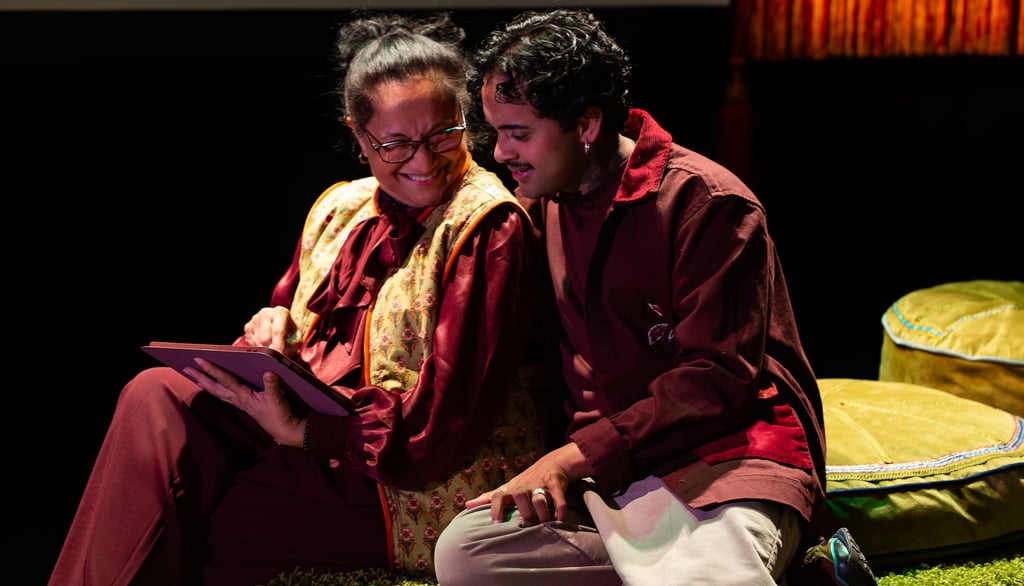
©️Photo by Christa Holka
Just three minutes before Second Trimester begins, Geetha Shankar, introduced simply as “mother,” is on stage, replying to WhatsApp messages projected for the audience. One of them reads: “Do they know you’re not a performer, you’re just a mum?” It resets the frame of the performance. From that point on, I kept circling the same question: What exactly am I watching? A story, a script, or an experience still in the process of being worked through? The piece keeps all these active together.
Krishna Istha’s writing, co-led by him and his mother Geetha, and developed with director Milli Bhatia and dramaturg Paula Varjack, is inspired by a very specific rupture. A few years ago, Istha, a queer and trans artist, told Geetha he was trying to get pregnant, and her reaction was overwhelming. That moment opens into a much larger landscape: family histories left incomplete, relationships that don’t fully come into view, emotional inheritances that sit under the surface. Krishna and Geetha work through their own experiences and memories, moving across questions of pregnancy, loss, gender, and parenthood, assembling the material live, with small variations each night.
Second Trimester follows First Trimester, where Krishna spoke with hundreds of people while searching for a sperm donor, using those encounters to think through trans pregnancy and parenthood. That earlier piece reached outward, gathering voices. Here, the direction turns inward. The focus is on what is already there, what has been carried for years, and what returns once it is given space.
The performance is divided into small episodes, almost like film clips, or fragments from a rehearsal that can be rearranged. During the process, Geetha takes control. She can continue, pause, step out, or insert a short “ad break” when the material becomes difficult to hold. It might sound like a formal device, but in practice it feels immediate. You can sense when she needs it. The system behind this, designed by Ruby Glaskin and Suzanna Hurst with video work by Anna West and Davi Callanan from “idontloveyouanymore”, turns the stage into a responsive system. Screens, live camera, and green screen techniques build a visual language that draws from Bollywood, heightened and mobile. The piece moves across places and timelines, following Geetha between India, the US, and different versions of family life.
The technical work sharpens the sense of proximity instead of creating distance. Set and costume designer Ting-Huan 挺歡 and Christeene Urquhart, lighting designer Joshua Gadsby, and sound designers Joe Jackson and XAN work closely together to shape a space that can expand and contract quickly. One moment it feels wide and cinematic, the next it narrows into something more exposed. You remain aware that choices are being made in real time.
At the centre is a mother and child working through questions of pregnancy, birth, family, and everything attached to those ideas. Telling becomes part of processing. Some of these stories feel like they have been waiting for a long time. There is grief in them, along with a sense of release in letting them take form in front of those witnessing it. What stays with me is how the piece treats theatre and storytelling as part of that process. Memory is not presented as stable. It shifts, repeats, and changes depending on how it is revisited. With every retelling, their relationship, both performed and lived, is reworked. The movement within it, and the tension it holds, make it deeply affecting and human.
The title points to a stage of becoming. It leaves me wondering how the final part of the trilogy will continue from here, and whether it will hold onto this sensitivity and fluidity or move into something more defined.
Sound Behind Curtain
A place for all Asian artists.
Your gift keeps the curtain rising for Asian creatives.
About
Contact
© 2026 Sound Behind Curtain. All rights reserved.
Terms & Conditions Privacy Policy