
REVIEW: The Gambler - Engaging
Review Date: 9th February 2026 @Chiten Theatre
REVIEWS
Kassy Fang
2/12/20262 min read
©️Photo by Dimitri Djuric
Adapted from Fyodor Dostoevsky’s novel, The Gambler arrives with a backstory almost as compelling as the fiction itself. Dostoevsky’s own gambling addiction famously bled into the book. In an attempt to repay mounting debts, he reportedly staked the full copyright of his work before writing a single word. That sense of desperation, obsession and self-entrapment hangs palpably over this production.
Chiten Theatre Company, under the direction of Motoi Miura, is known for its anti-traditional theatrical experiments and its reworking of Japanese culture and literature into new performative languages. What distinguishes the company most strongly is its rigorous attention to language and the way actors deliver text, an approach rarely seen elsewhere. Here, the script is constructed through a collage method. Dostoevsky’s original text is fragmented and distilled into short, looping passages. These fragments feel like the points where the text sticks, moments that are either irresistible or frustrating, producing a sense of desire that never quite settles.
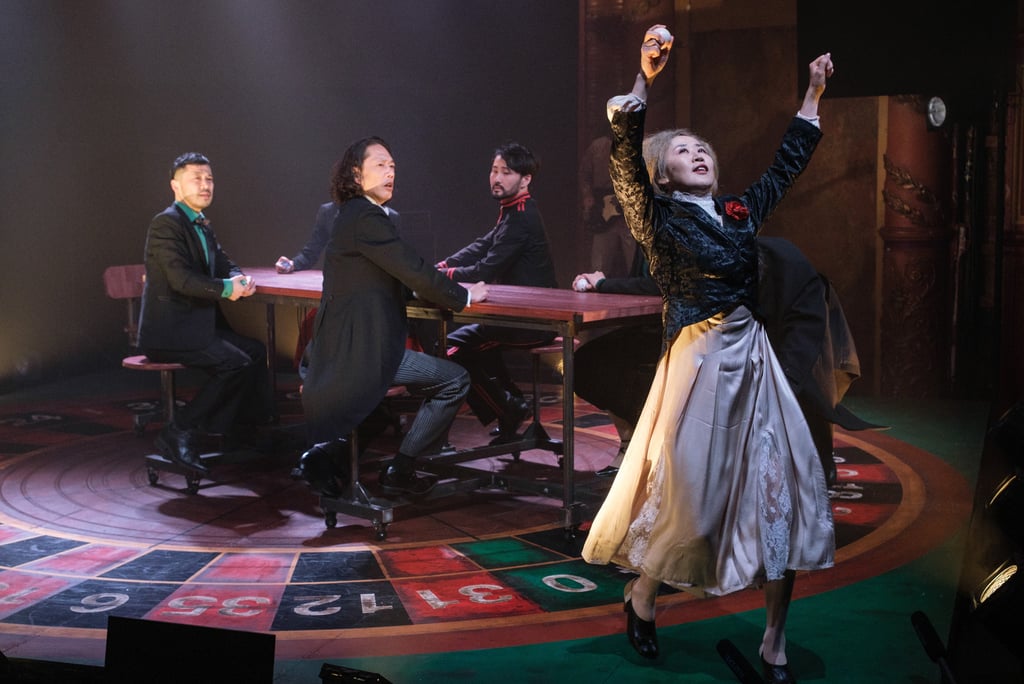
Gambling numbers are repeated obsessively. Someone shouts “check”, and the next second heads drop in despair or arms shoot up in triumph. Everyone speaks, yet speech is constantly interrupted by the next voice. Before delivering their lines, the actors strike the gambling table with billiard balls, competing for the audience’s attention. Dialogue circulates between characters without conversation or eye contact. Each line feels closer to a declaration, projected towards a fixed point beyond the audience. Japanese, English, French, Russian. A geographically distant imagination appears alongside a nostalgic distance in time. The unbridgeable nature of class is embedded in privilege and stagnation, echoing the circular rhythm that governs the entire piece.
Visually, the production is immediately arresting. Set designer Itaru Sugiyama transforms the stage floor into an enormous roulette wheel marked with red and black numbers. Characters sit around a long rotating table, driven ever faster by the increasingly unhinged Alexei. Colette Huchard’s costumes are striking and precisely matched to each character’s background and personality, with red, black and green recurring as visual motifs. The revolving set, eccentric choreographed movement and hidden mechanical systems combine with a ring of LED lights above the stage, which glow and shift in colour as they track the imagined roulette ball. Yasuhiro Fujiwara’s lighting design captures both the thrill and the agony of gambling, pushing the audience into a state of heightened sensory awareness that borders on excess. The production also experiments boldly with linguistics, rhythm and sound. Live music and percussion by Kukangendai, shaped by Bunsho Nishikawa’s sound design, intensify the sense of repetition, and the actors’ recurring gestures further deepen an atmosphere that feels psychologically warped and oddly unsettling.
Beneath the linguistic barriers and fractured narrative, the ninety-minute duration can feel relentless, mirroring the endless nature of gambling obsession itself. The adaptation prioritises themes over plot, which risks softening the narrative drive. Yet within its limited text, the production selects moments with precision, revealing character and conflict without relying on conventional storytelling. Instead, it immerses us in psychological states and emotional textures. Once you begin to reflect on the methods at work, the experience becomes deeply engaging, leaving behind a lingering curiosity and many questions one would love to ask the theatre company.
★★★★
For more information about this production, please visit: https://www.thecoronettheatre.com/whats-on/chiten-theatre-the-gambler/
Credits:
Text: Fyodor Dostoevsky
Translator: Ikuo Kameyama
Director: Motoi Miura
Musician: kukangendai
Cast: Takahide Akimoto, Midori Aioi, Yohei Kobayashi, Satoko Abe, Dai Ishida, Masaya Kishimoto, Shie Kubota
Set Designer: Itaru Sugiyama
Costume Designer: Colette Huchard
Lighting Designer: Yasuhiro Fujiwara
Sound Designer: Bunsho Nishikawa
Stage Manager: Atsushi Ogi
Producer: Yuna Tajima
Supported by the Agency for Cultural Affairs, Government of Japan and JLOX+
Sound Behind Curtain
A place for all Asian artists.
Your gift keeps the curtain rising for Asian creatives.
About
Contact
© 2026 Sound Behind Curtain. All rights reserved.
Terms & Conditions Privacy Policy