
REVIEW: The Köln Concert
Review Date: 11th April 2026 @The Barbican Hall
REVIEWS
Kassy Fang
4/14/20262 min read
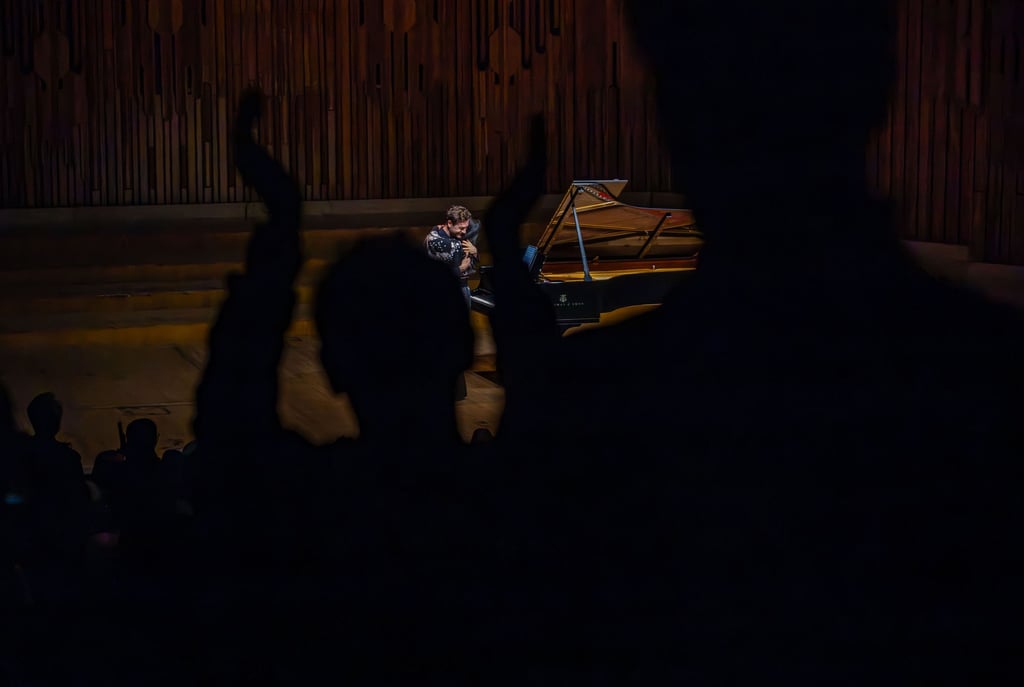
©️Photo by Luke O'Shea-Phillips
To write about The Köln Concert as reimagined by Maki Namekawa and Thomas Enhco is to circle a moment that has already passed into musical mythology, and to test how far it can breathe in the present.
The original concert, given by Keith Jarrett on 24 January 1975 at the Cologne Opera House, has been recounted so often that it risks becoming myth rather than history. The facts remain striking. Jarrett arrived exhausted. The piano provided for him was not the concert instrument he had requested: its tone was thin, the bass weak, and the sustain pedal unreliable. Faced with these limitations, he built the performance from modest materials, often returning to small clusters of chords and repeating figures, extending them into long arcs of improvisation. Out of constraint came a language of persistence and invention. The recording that followed became the best-selling solo piano album in jazz history, and its phrases still live vividly in the ears of listeners decades on.
This Barbican performance did not attempt a reconstruction so much as a continuation of that spirit. Namekawa opened alone, her presence composed and deliberate, the visual poise of her dress matched by a clarity of touch. The opening lines were finely shaped, allowing simple harmonies and repeated motifs to gather weight. There was a distinctly classical discipline in her phrasing, but it did not confine the music; instead, it created a ground from which improvisation could rise with quiet assurance. Even the sound of her heels marking time on the stage floor became part of the texture, a physical reminder that rhythm begins in the body.
Enhco’s entry shifted the atmosphere. His playing brought a wider harmonic palette, pushing the material into denser and more exploratory territory. As the improvisation unfolded, the language grew more abstract, though never detached. His gestures at the keyboard carried a sense of immersion, eyes closed, body moving with the current of the music, as if tracing the course of something fluid and unbroken. The effect suggested a long river in motion, each idea folding into the next without interruption.
When Namekawa returned, the transition was concise and telling. She allowed space to speak. Phrases would pause and dissolve, leaving resonance to hang in the air. These moments invited the listener to linger on what had just passed, to hear the afterimage of sound as part of the music itself.
Across the performance, echoes of the original concert’s architecture came into focus: sweeping right-hand runs, sharply etched intervallic accents, and passages that build momentum through repetition before easing into release. At times, the music leaned towards a gospel-inflected warmth; at others, it turned inward, pared back to a folk-like simplicity. What emerged most clearly was a shared commitment to improvisation as a living practice. The music held on to tonality, melody and structure, though none of these felt fixed in advance. Form seemed to arise in real time, shaped through listening as much as playing. Rooted in a steady rhythmic pulse and built through gradual accumulation, this language still carries a distinctly contemporary charge: something more open, coming into being in the moment.
Credits:
Musicians: Thomas Enhco, Maki Namekawa
★★★★
For more information about The Köln Concert , please visit: https://www.barbican.org.uk/whats-on/2026/event/the-koln-concert
Sound Behind Curtain
A place for all Asian artists.
Your gift keeps the curtain rising for Asian creatives.
About
Contact
© 2026 Sound Behind Curtain. All rights reserved.
Terms & Conditions Privacy Policy