REVIEW: Under The Shadow
Review Date: 10th June 2026 @Almeida Theatre
REVIEWS
Kassy Fang
6/11/20263 min read
©️Photo by Marc Brenner
★★★★
For more information, please visit: https://almeida.co.uk/whats-on/under-the-shadow/
Credits
Creator of Original Film: Babak Anvari
Adaptor: Carmen Nasr
Director: Nadia Latif
Set Designer: Ben Stones
Costume Designer: Khadija Raza
Lighting Designer: James Farncombe
Sound Designer: Donato Wharton
Casting Director: Anna Cooper CDG
Children's Casting Director: Amy Beadel CDG
Illusion Consultant: Scott Penrose
Fight Director: Kev McCurdy
Movement Director: Malik Nashad Sharpe
Costume Supervisor: Olivia Ward
Props Supervisor: Mary Halliday
Assistant Director: Layla Madanat
Dramatherapist: Dr Sara Alsaraf
Cast: Nadia Albina, Bijan Daneshmand, Souad Faress, Leila Farzad, Mona Goodwin, Nicholas Karimi and Rachid Sabitri.
Child Cast: Esma Akar, Rohan Berry, Atlanta Chaniac Golding, Adi Gimziunas, Erin Jemmotte
The first surprise of Under the Shadow is how inviting it feels.
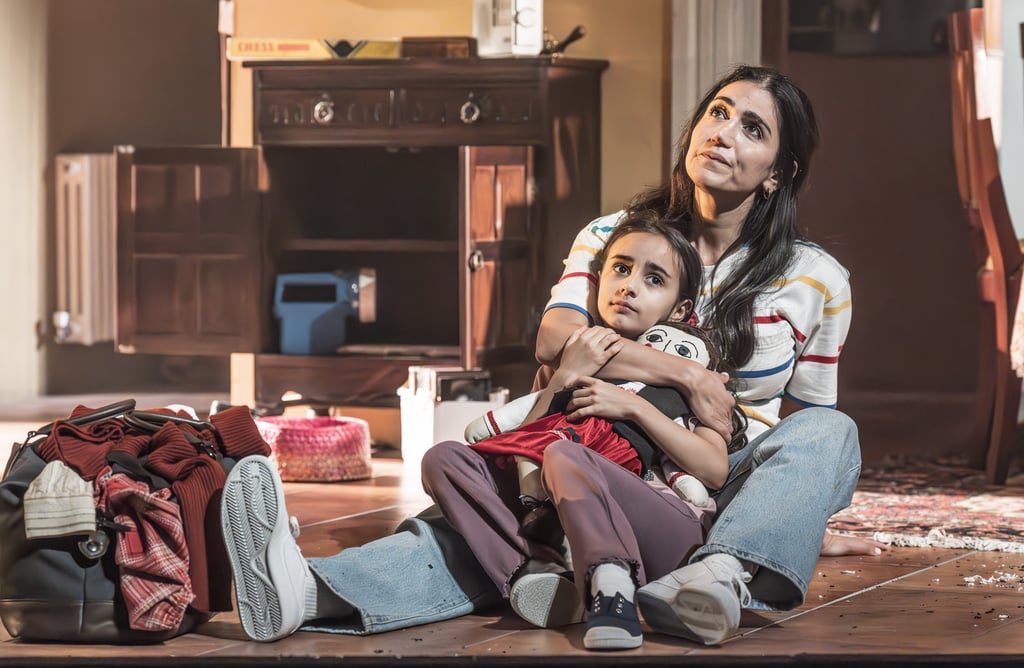
In Nadia Latif's production at the Almeida Theatre, Carmen Nasr's adaptation of Babak Anvari's film opens inside a middle-class Tehran apartment in 1988 during the period of the Iran-Iraq War. Ben Stones's meticulously detailed set is warm, tasteful and immediately relatable: afternoon sunlight spills through the side window; a Fondation Maeght poster advertising a Miró exhibition hangs on the wall; alone in the flat, Shideh exercises to a Jane Fonda workout tape.
The audience settles into this domestic familiarity before unease begins to seep through its edges. A telephone rings. Someone knocks at the door. Outside the apartment, disruptions are tearing through. Inside, everyday routines continue, increasingly shaped by forces that cannot be controlled.
One of Latif's most effective directorial choices is her attention to the wider community inhabiting the building. Scenes in the air-raid shelter offer a sharply observed portrait of communal life under siege. Khadija Raza's costumes help distinguish a range of personalities and social attitudes, while brief exchanges reveal different strategies for survival. Around Shideh, everybody is leaving. Some residents have already gone. Some are making plans. Some are urging others to do the same. The building grows emptier as the evening progresses.
"There is something." The phrase passes from neighbour to neighbour and hangs over the building. It points to something in the darkness, something in the distance, something approaching through the sky above Tehran. It also reflects a broader uncertainty created by war and political repression. Nobody seems able to explain exactly what it means, but everybody appears to feel it.
Several pressures come crashing into Shideh all at the same moment. She is living in a society that has denied her the opportunity to continue her medical education because of her past political activism. She is a mother, a wife and a woman trying to hold onto ambitions that no longer seem attainable. Fear, frustration and exhaustion slowly narrow the space available to her. The production allows these conflicts to accumulate, and war trauma takes on visible form. The supernatural elements are never detached from the reality surrounding them but emerge from it.
James Farncombe's lighting design is central to the production's success. Candlelit scenes possess extraordinary immediacy, while the changing quality of daylight across the apartment creates a convincing sense of passing time. Several horror sequences rank among the most accomplished stage illusions I have encountered in recent years.
Donato Wharton's sound design is equally precise. Air-raid sirens, missile strikes and distant bombardments never stop pressing against the walls of the apartment. The sounds puncture their fragile sanctuary, reminding them that beyond the walls, terror is drawing nearer.
The atmosphere is where this work is strongest. Its horror grows from recognisable human fears. Much of the fear comes from things left unseen. A noise from another room. A shadow crossing a wall. A pause that lasts a little longer than expected. The audience waits, listens and scans the space alongside the performers. By the final scene, as mother and daughter cling to each other while the sounds of bombardment continue beyond the walls, escape appears increasingly unlikely, but imagination offers a fleeting refuge from dread.
Sound Behind Curtain
A place for all Asian artists.
Your gift keeps the curtain rising for Asian creatives.
About
Contact
© 2026 Sound Behind Curtain. All rights reserved.
Terms & Conditions Privacy Policy