
REVIEW: Voyage & Hakk
Review Date: 1st June @On Tour
REVIEWS
Kassy Fang
6/2/20263 min read
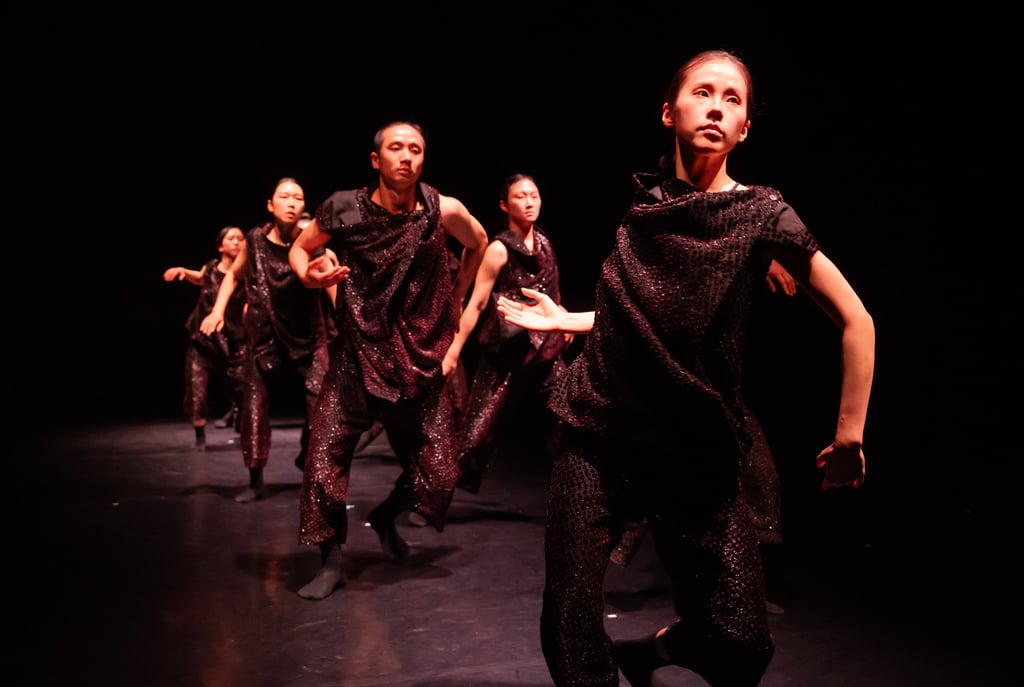
©️Photo by Ikin Yum
Presented at The Place as part of A Festival of Korean Dance 2026, Korea National Contemporary Dance Company's double bill presents two works linked by a common thread. Young-doo Jung's Voyage reaches towards the vast unknown of outer space, while Ryu Suzuki's Hakkō focuses on repetition, concentration and the body's capacity for change. Both pieces are visually rich, impeccably danced and share a fascination with collective human experience.
Voyage takes inspiration from NASA's Voyager probes, launched in 1977 and still travelling through interstellar space nearly fifty years later. Their mission was to venture beyond known territory, carrying the famous Golden Record — a collection of sounds, music and greetings intended to represent life on Earth.
Jung's choreography translates that sense of exploration into four scenes. The opening image is beautiful: a stage submerged in blue light, somewhere between the deep sea and deep space. Time appears suspended. The dancers appear in costumes by Young-jin Kim that combine traditional Korean influences with contemporary minimalism, grounding the work in both memory and possibility. The score, composed by Jae-rock Park, layers references to the Golden Record with rock, classical music and Korean traditional rhythms, converging within a shared sonic landscape.
The second section shifts the atmosphere. The movement becomes more animated, accompanied by a brighter musical tone. What caught my attention most was the dancers' use of their arms and hands. Rapid turns of the wrist, intricate finger articulations, and constantly changing gestures brought sign language to mind. It felt like watching humanity attempt to communicate with something beyond its understanding, testing different languages and systems in the hope of making contact.
The final scene leaves a lingering image. The dancers collectively tilt their heads upwards, shielding their eyes from an intense light above. Something appears to be arriving, or perhaps departing. A spacecraft? A new world? The choreography refuses to provide an answer. There is excitement in that uncertainty, but also hesitation. We encounter the unfamiliar and have no idea how long the journey will be, or where it will lead.
After the expansive scale of Voyage, Hakkō turns towards the body.
Inspired by the repetitive actions of the Japanese kendama toy, Suzuki builds an entire work from simple movements repeated again and again. The concept sounds straightforward; the result is surprisingly absorbing.
Time behaves differently in Hakkō. Small actions are stretched, revisited and transformed through repetition. A turn of the head, a shift in weight, a rotation of the torso. Nothing appears dramatic in isolation, but gradually the accumulation of movement creates its own momentum.
Lighting designer Jung-hwa Kim and sound director Dong-june Lee play a major role in shaping the atmosphere. As dancers slowly rotate left and right, light strikes the face at different angles, producing fleeting sculptural images. They resemble statues emerging from darkness before dissolving back into the haze.
What makes the piece so effective is the commitment of the performers. Through repetition, the sense of individual identity begins to dissolve. The dancers seem to enter a shared state of concentration, driven by pulsating electronic music and rhythms drawn from club culture. The work has been described as a modern prayer, and that feels accurate. The choreography keeps returning to the act of breathing, persisting and continuing.
Viewed together, Voyage and Hakkō speak to one another in unexpected ways. One looks outwards towards the cosmos; the other looks inwards through repetition and focus. Both are concerned with collective experience, with people moving through uncertainty together. Whether facing the infinite possibilities of space or the relentless passage of time, these performers embody something recognisably human: curiosity, endurance and the search for connection.
★★★★
For more information, please visit: https://theplace.org.uk/events/summer-25-voyage-hakk%C5%8D-lowry/
Credits:
Voyage
Choreographer: Young-doo Jung
Movement Co-Creation & Dancers: Da-som Kang, Yu-jin An, Soo-yeon Lee, You-jin Lee, Jin-woo Lee, Hyeon-soo Jeon, Sun-min Jung, Yoon-hee Choi
Composer & Music Director: Jae-rock Park
Costume Designer: Young-jin Kim
Hakkō
Choreographer: Ryu Suzuki
Dancers: Myeong-seon Kim, Eun-joo Kim, Joo-ho Roh, Min-ji Park, Jun-young Park, Mo-sung Ok, Jeong-eun Lee, Jong-ung Jeong
Composer & Music Director: Tatsuki Amano
Costume Designer: Ho-jin Jeong
Lighting Designer: Jung-hwa Kim
Stage Manager: Eun-jin Jo
Sound Director: Dong-june Lee
Part of A Festival of Korean Dance 2026, presented by The Place and the Korean Cultural Centre UK, in partnership with Lowry, Tramway, Dance City and Pavilion Dance South West, and supported by SIDance and MODAFE.
Hakkō was developed from a creative research project initiated through TAMA (2024) and Wings - an international dance project for emerging creators at Dance Base Yokohama.
Sound Behind Curtain
A place for all Asian artists.
© 2026 Sound Behind Curtain. All rights reserved.
Your gift keeps the curtain rising for Asian creatives.
About
Contact